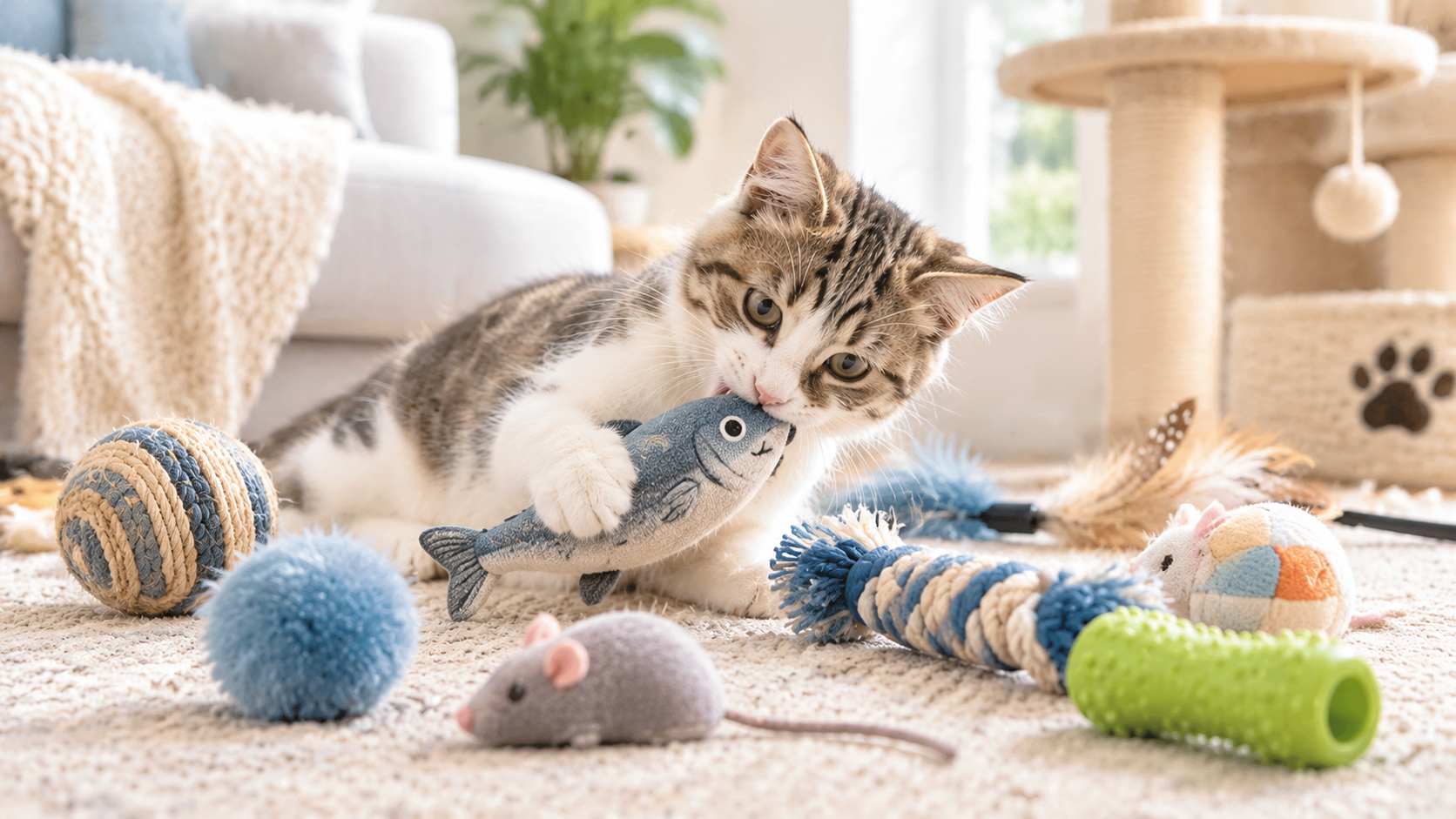
A pet toy may look durable, but what happens after ten minutes of chewing? Torn plush or detached squeakers aren’t just bad reviews—they’re choking hazards. Sourcing from China? You must test tear strength and small-parts risks before mass production, not after products reach customers.
1. Why Pet Toy Durability Matters More Than Appearance
Pet toys are exposed to repeated physical stress. Dogs may chew, shake, pull, stretch, and bite different parts of a toy, often in ways that are difficult to predict.
A product that passes a basic visual inspection may still fail during normal use.

1.1 Common Pet Toy Failure Points
Different toy materials and structures create different risks.
- Plush toys: Weak stitching, poorly secured seams, and loose fabric components may allow stuffing or internal parts to escape.
- Rubber toys: Thin sections, weak joints, or inconsistent material quality may lead to tearing or broken fragments.
- Rope toys: Loose fibers and unraveling strands may create ingestion concerns.
- Squeaky toys: Poorly secured squeakers may detach after repeated chewing.
- Interactive toys: Small decorative or functional components may loosen under pulling or impact.
The important question is not simply whether a toy breaks. It is how it breaks, which components become accessible, and what risks those components may create.
1.2 A Durability Problem Can Become a Brand Liability
For an overseas pet brand, a product failure can affect several parts of the business:
- Customer complaints and negative product reviews
- Refunds, replacements, and additional customer service costs
- Retailer concerns about product reliability
- Potential product safety investigations or recalls
- Damage to long-term brand trust
Not every damaged toy will cause an injury, and not every material failure automatically means a product is unsafe. However, brands should treat foreseeable breakage and accessible small components as issues requiring proper evaluation.
2. How to Test Pet Toys for Tear Strength
Tear strength is one of the most useful properties to evaluate when developing pet toys made from fabric, rubber, or other flexible materials.
However, there is no single universal tear-strength test that applies to every pet toy. The testing method should reflect the material, product construction, and intended use.
2.1 Plush Dog Toys: Test Stitching and Seam Strength
For plush toys, the fabric itself is only part of the equation. The seams connecting different sections may be the first areas to fail.
A practical testing plan should examine:
- Stitch density and consistency
- Seam construction and reinforcement
- Fabric resistance to tearing
- Attachment strength of ears, tails, and other external components
- Security of internal squeakers and accessories

A seam pull test can help evaluate how much force a specific seam withstands before opening or separating.
For example, a brand developing a plush dog toy could identify the neck, legs, and side seams as priority testing areas. These sections may experience repeated pulling during play.
The test should record the applied force, test location, failure point, and whether stuffing or internal components become accessible.
2.2 Rubber Dog Toys: Evaluate Tearing and Structural Weakness
Rubber toys need a different approach.
A product may feel firm in the hand but still contain thin sections, sharp transitions, or weak connection points that become vulnerable under repeated chewing.
Consider evaluating:
- Material consistency
- Wall thickness in high-stress areas
- Resistance to tearing and cracking
- Strength around openings and molded features
- Performance after repeated compression or deformation
For a rubber chew toy, testing only the thickest section is not enough. Thin edges, grooves, holes, and connecting points should also be considered.
If the product contains multiple materials, each material interface may require separate evaluation.
2.3 Use Test Methods Appropriate to the Product
A useful testing program may include tensile, seam-strength, tear-resistance, compression, or repeated-use evaluations, depending on the product design.
ASTM standards may provide relevant test methods for particular materials or product characteristics. However, a material test alone does not prove that a complete pet toy is safe.
Brands should work with a qualified laboratory or product safety specialist to identify suitable methods and acceptance criteria.
A test report is most useful when it clearly identifies the tested sample, material, method, conditions, results, and failure observations.
3. Small Parts Testing: Preventing Choking and Ingestion Hazards
A pet toy can remain largely intact while one small component becomes detached.
This is why small-parts evaluation deserves separate attention.
3.1 Identify Components That Could Come Loose
Before production, review the complete product and list every component that could potentially detach during foreseeable use.
Examples include:
- Plastic eyes and noses
- Buttons and decorative pieces
- Squeakers and sound-producing components
- Small molded accessories
- Bells or other metal components
- Plastic connectors and fasteners
The risk depends on the component’s size, shape, material, attachment method, and the way an animal may interact with it.
A small detached component may create a choking or ingestion hazard. Sharp or broken fragments may introduce additional injury risks.
3.2 Evaluate Components After Durability Testing
Testing a component before it is attached to the toy is not enough.
The attachment should also be evaluated as part of the finished product.
A practical assessment may include:
- Inspect the component and its attachment method.
- Apply appropriate pulling or separation forces.
- Repeat relevant durability or simulated-use tests.
- Examine whether the component becomes loose or detached.
- Record the condition of the product and any resulting fragments.
For example, if a plush toy uses plastic eyes, the brand should evaluate whether the eyes remain securely attached after the relevant seam and pulling tests.
If a squeaker is enclosed inside a rubber toy, the evaluation should consider whether the surrounding material can tear and expose the squeaker.
3.3 Do Not Treat a Small-Parts Test as a Complete Pet Safety Test
Small-parts testing is an important part of product risk assessment, but it should not be treated as a universal guarantee of pet safety.
Some small-parts procedures are designed for children’s products and may not directly represent the risks associated with pet toys.
The applicable requirements and test methods should be selected according to the product, intended market, and relevant regulations or retailer requirements.
For brands selling in the United States or Europe, a qualified laboratory or product compliance specialist can help determine which evaluations are appropriate.
4. How to Build a Practical Pet Toy Durability Testing Plan
A strong testing plan does not need to be complicated. It needs to be specific, repeatable, and connected to the actual product.
Here is a practical framework for overseas brands working with Chinese manufacturers.
Step 1: Define the Intended Use
Start by describing how the toy is designed to be used.
Consider:
- Intended animal size or weight range
- Chewing intensity or play style
- Whether the product is designed for supervised play
- Whether it contains detachable or interactive components
- Any age, size, or usage limitations stated on the packaging
A soft plush toy and a heavy-duty rubber chew toy should not automatically share the same acceptance criteria.
Step 2: Identify the Most Vulnerable Areas
Review the product design and identify likely failure points.
| Product type | Priority areas to evaluate |
|---|---|
| Plush toys | Seams, stitching, fabric, attached features |
| Rubber toys | Thin walls, grooves, openings, molded joints |
| Rope toys | Knots, loose fibers, connection points |
| Squeaky toys | Squeaker enclosure and attachment |
| Interactive toys | Small components, connectors, moving parts |
This helps the factory and testing laboratory focus on the areas most relevant to the product.
Step 3: Set Measurable Acceptance Criteria
Avoid vague requirements such as “high durability,” “strong stitching,” or “not easy to break.”
Instead, define measurable criteria where an appropriate method exists.
For example:
- Specify the minimum seam strength for selected construction areas.
- Identify the relevant test method and testing conditions.
- Define acceptable material and dimensional tolerances.
- Specify that designated components must not detach during the agreed evaluation.
- Define how broken, sharp, or accessible fragments will be assessed.
The actual limits should be established through product development, risk assessment, applicable requirements, and laboratory advice—not invented as universal numbers.
Step 4: Test Production-Representative Samples
A hand-finished development sample may not accurately represent mass production.
Before approving an order, request samples made with the intended production materials, construction methods, and components.
Where appropriate, conduct a pilot production run and select samples from the actual production process.
This helps reveal differences caused by material batches, stitching methods, molding conditions, or assembly practices.
Step 5: Record Results and Control Changes
Keep a record of:
- Product model and sample identification
- Material and component specifications
- Test methods and conditions
- Test results and failure observations
- Corrective actions
- Final approval status
If the factory changes a material, component, mold, or construction method, determine whether the change affects the previous test results.
Do not assume that an approved sample automatically covers every later production variation.
5. What Overseas Brands Should Require from Chinese Pet Toy Suppliers
When sourcing pet toys from China, the factory’s production capability is important—but so is its ability to follow clearly defined product requirements.
Before mass production, brands should align with suppliers on the following points.

5.1 Material and Component Control
Ask the supplier to identify the materials used in the product, including fabric, rubber, stuffing, coatings, adhesives, and attached components where relevant.
Require approval before substitutions that could affect durability, safety, or compliance.
5.2 Testing Responsibilities
Agree on who will arrange testing, which samples will be tested, which methods will be used, and how results will be documented.
If third-party laboratory testing is needed, confirm the laboratory’s scope and suitability before placing the order.
5.3 Production Consistency
The approved sample should represent the intended mass-production construction.
The supplier should not change stitching, material thickness, component attachment, or other critical specifications without approval.
5.4 Inspection and Corrective Actions
Define what happens if a sample or production batch fails the agreed criteria.
The process should cover investigation, corrective action, re-testing where necessary, and approval before affected products are released.
A written agreement makes expectations clearer for both the brand and the manufacturer.
Conclusion: Test How Pet Toys Fail, Not Just How They Look
A pet toy should not be judged only by its appearance when it leaves the factory.
For overseas brands, a more reliable approach is to understand how the product may fail during foreseeable use, identify the components that could become accessible, and test the finished construction against clearly defined requirements.
Tear strength, seam performance, component attachment, and small-parts evaluation all contribute to a more complete durability assessment.
When sourcing from China, these requirements should be discussed during product development and confirmed before mass production. This gives brands a better opportunity to address weaknesses before products reach customers.
Frequently Asked Questions
1. How do you test the durability of dog toys?
The appropriate method depends on the material and design. Common evaluations may include seam-strength, tensile, tear-resistance, compression, repeated-use, and component-attachment testing. The test plan should reflect the toy’s intended use and potential failure points.
2. What is a tear strength test for pet toys?
A tear-strength test evaluates how a material or construction resists the growth of a tear under specified conditions. It can be relevant to fabric, rubber, and other flexible materials, but the method must be suitable for the material being tested.
3. How can brands prevent choking hazards in dog toys?
Identify components that could detach, evaluate their attachment to the finished toy, and examine the product after relevant durability testing. Also review whether breakage could expose small, sharp, or otherwise hazardous fragments.
4. Are small-parts tests enough to prove a pet toy is safe?
No. Small-parts evaluation addresses only part of the potential risk. A broader assessment may also need to consider material properties, breakage, sharp edges, chemical requirements, intended use, and applicable market regulations.
5. What should brands test in plush dog toys?
Focus on seam strength, stitching consistency, fabric tear resistance, attached features, and the security of internal components such as squeakers. Pay particular attention to areas likely to experience pulling during play.
6. How often should pet toys be tested during production?
Testing frequency should be based on product risk, production consistency, supplier performance, and the brand’s quality plan. Initial approval, pilot production, material changes, and significant production changes are useful points for review.
7. Can Chinese manufacturers provide pet toy testing reports?
Some manufacturers can provide existing reports or arrange testing through laboratories. Brands should verify that each report matches the actual product model, materials, components, and relevant test method. An unrelated report should not be accepted as proof of compliance.
8. What should be included in a pet toy quality control agreement?
Include material and component specifications, approved construction details, relevant durability tests, acceptance criteria, change-control procedures, inspection responsibilities, and corrective-action requirements. The agreement should clearly identify what happens when a product fails the agreed evaluation.