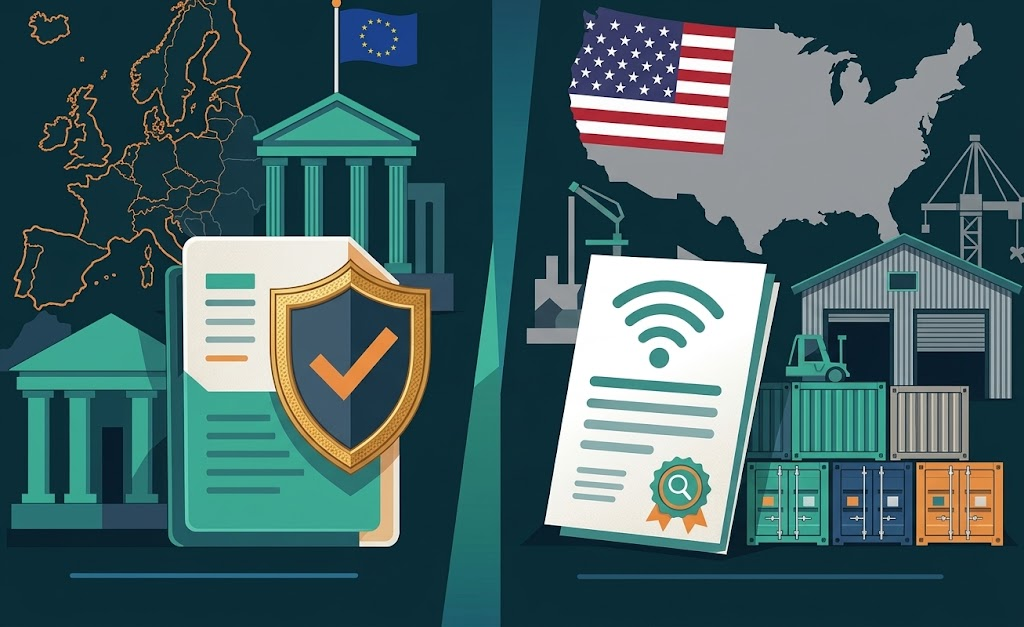
Sourcing from China for both the US and EU? A product compliant in the US often needs entirely different testing, labeling, and environmental compliance (CE, WEEE, EPR) for Europe. Don’t assume supplier certificates guarantee both markets. Verify exact requirements early to avoid costly delays.
- Why US and European Product Compliance Systems Are Different
- CE vs. FCC: Understanding the Key Certification Differences
- European Environmental Compliance: EPR, WEEE, and Packaging Requirements
- Common Compliance Mistakes When Sourcing from China
- How to Build Compliance into Your China Sourcing Process
1. Why US and European Product Compliance Systems Are Different
The biggest difference between the US and European markets is not simply the number of certificates required. It is how product safety, conformity, and producer responsibilities are organized.
1.1 The US: Product Requirements Depend on the Regulatory Agency
In the United States, product requirements are managed by different federal agencies depending on the product category.
For example:
The Consumer Product Safety Commission oversees many consumer product safety requirements.
The Federal Communications Commission regulates radio-frequency devices and equipment that may cause harmful interference.
The Food and Drug Administration regulates products such as food, cosmetics, medical devices, and certain other regulated categories.
The Environmental Protection Agency oversees specific environmental and chemical-related requirements.
This means a product does not automatically need every type of certification. Its regulatory obligations depend on its intended use, technical characteristics, materials, and applicable regulations.
For an overseas brand, the first step is identifying which requirements apply to the actual product being sold.
In the US, there is no single “product certificate” office. Different agencies look after different product types — so what your product needs depends on what it is and how it works.
1.2 Europe: A More Integrated Product Compliance Framework
The European Union uses harmonized legislation for many product categories. Depending on the product, manufacturers may need to demonstrate conformity with requirements covering safety, health, electromagnetic compatibility, chemical restrictions, or environmental protection.
For example:
Products covered by specific EU legislation must demonstrate conformity before placement on the market.
Limits certain hazardous substances in electrical and electronic equipment.
Addresses chemicals and substances of very high concern used in products.
Establishes general safety obligations for consumer products within its scope.
One important distinction: CE marking is not required for every product sold in Europe. Products outside the scope of CE-specific legislation must not carry the CE mark simply because a supplier offers a certificate.
For brands selling under their own name, the responsibilities can be significant. Under EU product rules, a company that has a product manufactured and markets it under its own brand may be treated as the manufacturer, with corresponding compliance obligations.
If you sell the product under your own brand in Europe, the law may treat you as the manufacturer — even though a Chinese factory made it. The paperwork and responsibility follow the brand, not just the factory.
A product’s compliance requirements should be determined by its category and destination market, not by the certificates a factory already has available.
2. CE vs. FCC: Understanding the Key Certification Differences
CE and FCC are frequently mentioned together in international sourcing conversations. However, they are not interchangeable certifications.
2.1 What Does CE Marking Mean?
CE marking indicates that a product meets the applicable EU requirements covered by the relevant harmonized legislation.
Depending on the product, this may involve requirements related to:
- Electrical safety
- Electromagnetic compatibility (EMC)
- Radio equipment
- Machinery safety
- Toy safety
- Personal protective equipment
Before placing a CE-marked product on the EU market, the responsible manufacturer must identify the applicable legislation, complete the required conformity assessment, prepare technical documentation, and issue an EU Declaration of Conformity where required.
Not every product requires an independent laboratory or notified body. Some products can follow a permitted manufacturer self-assessment procedure, while other product categories require third-party assessment.
There is also no single central EU authority that issues a universal CE certificate for every product.
2.2 What Does FCC Compliance Mean?
FCC requirements are primarily relevant to products that generate or use radio-frequency energy.
Common examples include:
- Bluetooth-enabled products
- Wi-Fi devices
- Wireless remote controls
- Certain electronic accessories
- Digital devices that may generate radio-frequency emissions
Depending on the device and applicable FCC rules, equipment may need authorization through Certification or Supplier’s Declaration of Conformity (SDoC).
A product intended for the US market may therefore need FCC compliance even if a similar product sold in Europe follows a different conformity assessment route.
2.3 CE vs. FCC: A Practical Comparison
| Comparison | CE Marking (EU) | FCC Compliance (US) |
|---|---|---|
| Main purpose | Demonstrates conformity with applicable EU product legislation | Addresses applicable US radio-frequency and interference requirements |
| Main authority/framework | Relevant EU legislation and national market surveillance authorities | Federal Communications Commission |
| Product scope | Specific product categories covered by CE legislation | Applicable radio-frequency devices and equipment |
| Typical examples | Toys, electrical equipment, radio equipment, machinery | Bluetooth devices, Wi-Fi products, digital electronics |
| Assessment route | Depends on the applicable EU legislation | Depends on the applicable FCC authorization procedure |
| Main documentation | Technical documentation and, where required, EU Declaration of Conformity | Applicable test records and authorization or SDoC documentation |
A common mistake is assuming that a product with FCC compliance can automatically enter the European market, or that CE marking is enough for US sales.
Neither assumption is safe.
For example, a Bluetooth pet tracking device may require FCC equipment authorization for the US market and compliance with the applicable EU Radio Equipment Directive requirements for Europe. The exact testing and documentation depend on the device design and applicable rules.
CE and FCC address different regulatory frameworks. Always confirm the destination-market requirements for the exact product model.
Can You Pass the Compliance Quiz?
Tap an answer to check yourself — no email, no form. A quick gut-check before you read on.
3. European Environmental Compliance: EPR, WEEE, and Packaging Requirements
For many overseas brands, European compliance does not stop when a product passes its safety tests.
Environmental responsibilities can also affect the cost and administration of selling products in Europe.
Three areas deserve particular attention.
3.1 Packaging EPR: Your Packaging Can Create Legal Responsibilities
Extended Producer Responsibility (EPR) requires businesses placing certain products or packaging on a market to contribute to the management of the resulting waste.
For packaging, this can involve:
- Registering with the relevant national system
- Reporting packaging quantities and materials
- Paying applicable recycling or waste-management fees
- Meeting country-specific reporting requirements
A brand importing products from China should not assume that the factory is automatically responsible for these obligations.
The relevant responsibility depends on the business model, the country of sale, and who is legally considered the producer under the applicable rules.
The EU Packaging and Packaging Waste Regulation (PPWR) began applying on 12 August 2026, with implementation details and national arrangements requiring attention. Small businesses may benefit from certain flexibilities, but exemptions should never be assumed without checking the applicable rules.
3.2 WEEE: Requirements for Electrical and Electronic Products
If your brand sells electrical or electronic products in Europe, Waste Electrical and Electronic Equipment (WEEE) obligations may apply.
These can include:
- Registration with national WEEE authorities
- Reporting the quantity of equipment placed on the market
- Financing or organizing collection and treatment of electronic waste
- Participating in an approved compliance scheme where required
A wireless grooming device, electronic pet accessory, or rechargeable household product may therefore involve responsibilities beyond ordinary product safety testing.
Importantly, WEEE obligations are administered through national systems. Selling in several EU countries may require separate registrations and reporting.

In Europe, even your cardboard box has rules. If you put packaged products on an EU market, you may need to register, report, and pay recycling fees — country by country. Your factory will not do this for you.
3.3 Why Packaging Design Matters Before Production
Environmental compliance can also influence product and packaging decisions.
For example, a brand may initially request:
- A large printed cardboard box
- Multiple plastic inserts
- Individual plastic bags
- Decorative packaging components
However, the final packaging configuration can affect material reporting, waste obligations, and overall packaging costs.
Discussing packaging materials before mass production gives brands more opportunities to optimize the design without compromising product protection or brand presentation.
European compliance includes more than product certificates. Packaging and electronic waste responsibilities should be considered when planning the product and its distribution markets.
4. Common Compliance Mistakes When Sourcing from China
Even experienced overseas buyers can overlook compliance details when working with Chinese manufacturers.
Here are four mistakes worth avoiding.
A report from a past project may cover a different model, material, or configuration — always verify the exact model.
“CE and FCC, so it sells worldwide” is an oversimplification — rules differ by country, even within Europe.
A swapped plastic, adapter, or wireless module can invalidate the original compliance assessment.
Discovering a missing test, label, or registration after production means costly rework and delay.
4.1 Accepting a Certificate Without Checking the Product Model
A supplier may send a test report or certificate from a previous project. However, that document may relate to a different model, material, component, or configuration.
Before accepting it, verify:
- The exact product model
- The manufacturer and applicant information
- The tested components and configuration
- The applicable standards and test scope
- The document’s validity and authenticity
A report for one wireless device does not automatically cover every product in the same product family.
4.2 Assuming One Certificate Covers Every Market
A supplier might say, “Our product has CE and FCC certificates, so it can be sold worldwide.”
This is an oversimplification.
Different countries and regions have different legal requirements. Even within Europe, environmental registration and reporting obligations may differ by country.
Ask the supplier which specific requirements the documents address, rather than accepting a general statement that the product is fully certified.
“We have CE and FCC, so it can be sold worldwide” sounds reassuring — but it usually means the supplier tested one model for one market and is quoting the paperwork for everything.
4.3 Changing Materials or Components After Testing
A product can change during development.
A factory might replace a plastic material, modify a power adapter, change a wireless module, or use a different supplier for a key component.
These changes can affect the original compliance assessment.
Brands should establish a clear approval process for material and component changes. If a change could affect compliance, the relevant documentation and testing should be reviewed before production continues.
4.4 Leaving Compliance Until the Goods Are Ready to Ship
Discovering a missing test, label, or registration requirement after production can be expensive.
The brand may need to arrange additional testing, revise packaging, correct labels, or delay shipment.
Compliance planning should therefore begin during product development, not after the production order has been completed.
5. How to Build Compliance into Your China Sourcing Process
A reliable sourcing process should connect product specifications, supplier communication, documentation, and production control.
Here is a practical checklist for overseas brands.
Lock where you will sell before requesting quotes.
Map each product’s applicable rules and documents.
Confirm reports match the final product before mass production.
Block unapproved material or component swaps in contracts.
Re-check EPR, WEEE and national rules before shipping.

5.1 Step One: Define Your Destination Markets
Before requesting quotations, identify where the product will be sold.
For example:
- United States only
- European Union only
- United States and selected EU countries
- Multiple international markets
This information helps determine which regulatory requirements need to be reviewed before sourcing begins.
5.2 Step Two: Create a Product Compliance Checklist
Do not simply ask a supplier, “Do you have CE?”
Instead, prepare a product-specific checklist covering:
| Area | What to Confirm |
|---|---|
| Product category | Which regulations apply to the product? |
| Product safety | What safety standards and assessments are required? |
| Electrical or wireless functions | Are CE-related requirements or FCC authorization applicable? |
| Materials | Are relevant chemical restrictions covered? |
| Packaging | Which EPR and packaging obligations apply in each destination country? |
| Electronic products | Are WEEE registration and reporting obligations relevant? |
| Documentation | Are test reports, declarations, labels, and technical records available? |
The checklist should be reviewed against the actual product design and destination market.
5.3 Step Three: Verify Documents Before Mass Production
Request the relevant documentation during supplier evaluation and product development.
Check whether the reports match the actual product and whether the testing covers the final configuration.
If the product is still being modified, identify which changes could require additional assessment.
5.4 Step Four: Control Changes During Production
Include clear requirements in supplier agreements.
For example:
- No unapproved changes to critical materials or components.
- No substitution of tested electronic components without review.
- Product labels and packaging must follow the approved specifications.
- Relevant compliance documents must be updated when necessary.
- Production samples must match the approved product configuration.
These controls help prevent a compliant development sample from becoming a different product during mass production.
5.5 Step Five: Review Country-Specific Obligations Before Shipping
For European sales, check the relevant national requirements for packaging EPR, WEEE, and other applicable producer responsibilities.
For US sales, confirm the applicable federal and product-category requirements.
Do not assume that one registration or document automatically covers every destination market.
Decide your markets first, build a product-specific checklist second, verify the paperwork before mass production third, lock down component changes fourth, and re-check country rules before shipping fifth. Five steps, in order, every time.
Frequently Asked Questions
1. Is CE marking required for every product sold in Europe?
No. CE marking is mandatory only for product categories covered by specific EU legislation requiring it. Products outside those categories must not carry CE marking simply because a supplier provides a certificate.
2. Is FCC certification equivalent to CE marking?
No. FCC requirements primarily address applicable radio-frequency devices and electromagnetic interference in the United States. CE marking demonstrates conformity with relevant EU product legislation. They serve different regulatory purposes.
3. Can a Chinese factory provide all the documents needed for European compliance?
A factory may provide test reports, technical information, and product documentation. However, the brand or other legally responsible economic operator must ensure that the applicable requirements are met. A supplier’s documents should always be verified against the actual product and destination market.
4. Does EPR apply to products imported from China?
It can. Businesses placing packaged products or relevant electrical and electronic equipment on EU national markets may have EPR obligations. The responsible party depends on the business model and national rules.
5. Do US brands need to register for EPR before selling in Europe?
Depending on the products, packaging, and countries involved, they may need to register with relevant national systems and meet reporting or fee obligations. Requirements should be checked country by country.
6. When should brands discuss compliance with Chinese suppliers?
Ideally, before finalizing product specifications and placing a mass production order. Early planning helps avoid unnecessary redesign, retesting, relabeling, and shipment delays.
7. Can the same product be sold in both the US and Europe?
Yes, in many cases. However, the product may need different testing, documentation, labeling, or registrations to meet the requirements of each market.
8. What should I ask a Chinese supplier before placing an order?
Ask for the exact product model, applicable test reports, material information, component specifications, compliance documentation, and details of any previous product changes. Also clarify which market requirements the supplier’s documents actually cover.
Right product. Right paperwork. Right market.