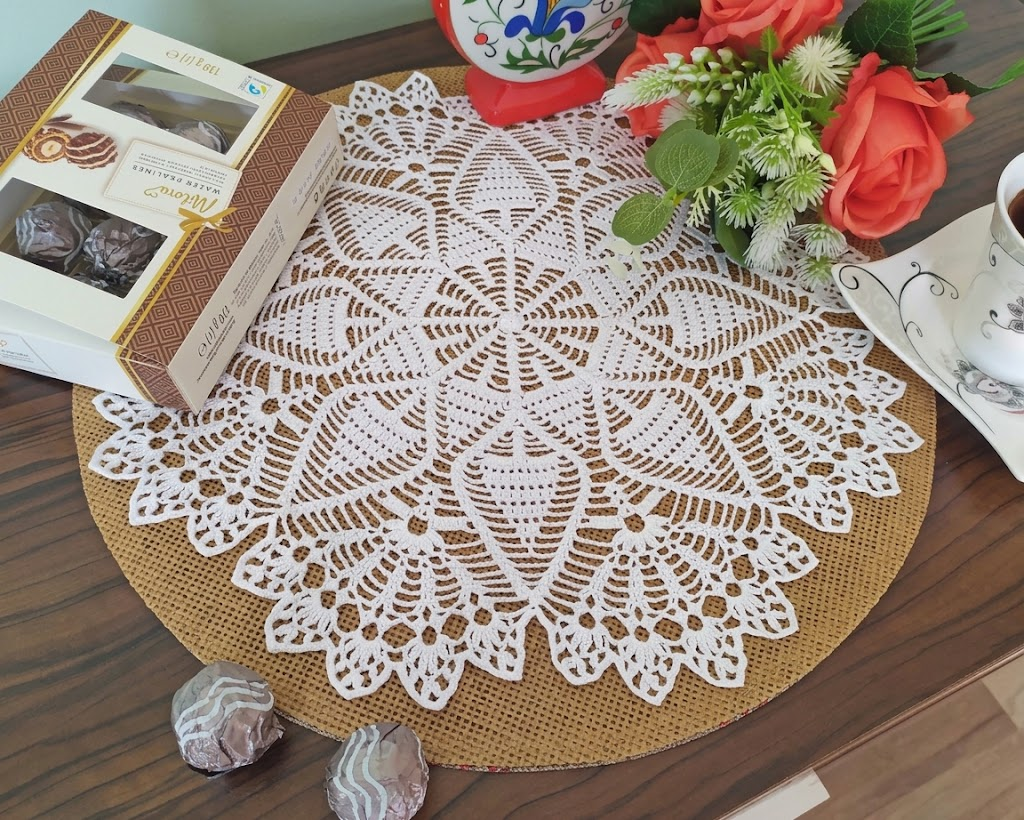
A lace doily looks simple: a circular shape, an intricate openwork pattern, delicate edges and a vintage-inspired appearance. But behind that familiar look can sit several completely different products — and in 2026, that distinction matters more than ever.
Pinterest’s 2026 trend report identifies Laced Up as an emerging cross-category aesthetic. Searches for “lace doily” increased by 105%, while lace bandanas and lace nails also recorded significant growth. The report describes doilies moving beyond traditional table settings and becoming decorative elements in their own right.
For home decor brands, this creates opportunities across table linens, wall decorations, decorative accessories and vintage-inspired collections. But a growing trend does not automatically create a reliable supply chain. The real challenge is translating a visual trend into a material and manufacturing specification that a supplier can consistently deliver.
The Trend Is Real: The Material Label Is Not
Lace has always been associated with craftsmanship, delicacy and decorative detail. What is changing is how brands use it. Traditionally, a lace doily was primarily a tabletop accessory, placed under a vase, candle holder or decorative centerpiece. Today its role can be much broader:
- Tabletop decoration and dining accessories
- Decorative wall hangings
- Vintage-inspired home accessories
- Layered table settings and event styling
- Decorative overlays for furniture and shelving
- Gift sets and seasonal home collections
A small lace doily can become a relatively accessible way for a brand to introduce a romantic, nostalgic or handcrafted aesthetic. However, there is a problem with the way the product is described online: the term “lace doily” tells buyers what an item looks like. It does not necessarily tell them how it is made.
Four different products can share the same search term
When searching for a lace doily supplier, buyers may encounter at least four different manufacturing options.
- Appeal comes from visible stitch structure and a handcrafted appearance.
- Natural variation in tension, stitch density, dimensions and edges is expected.
- Acceptable variation must be defined before production — not discovered after.
- More consistent patterns, scalable production and potentially lower unit costs.
- Not automatically inferior to handmade crochet for repeat orders.
- Often the more suitable choice when consistent dimensions matter.
- Creates a more pronounced, structured appearance than fine net lace.
- Watch motif density, connecting sections, edge construction and shape retention.
- A lace style, not a single fiber specification — materials and processes vary.
- Designed for disposable food presentation, baking, gift wrapping or temporary decor.
- Different manufacturing, material, packaging and intended use.
- Should never be placed in the same quotation comparison as textile doilies.


What to Specify Instead of Simply Asking for a Lace Doily
A common mistake in product sourcing is starting with a reference image and expecting suppliers to understand every detail of the intended product. A photograph may communicate the overall design, but it cannot reliably communicate fiber composition, stitch construction, finishing requirements or acceptable production variation.
For brands sourcing crochet lace doilies wholesale or developing custom lace home accessories, the purchasing brief should answer five questions.
A. What is the actual manufacturing method?
Define whether the product should be handmade crochet, machine-made lace, guipure lace, embroidered lace or a paper decoration. These are not interchangeable. If your reference has visible crochet loops, a factory offering a machine-made polyester alternative may reproduce the silhouette but not the texture or construction — and that difference should be discussed before requesting a quotation.
B. What fiber composition do you require?
| Material | Typical characteristics | Sourcing considerations |
|---|---|---|
| Cotton | Natural fiber with a familiar textile feel | Yarn quality, softness, shrinkage and dimensional stability |
| Polyester | Suitable for repeatable machine-made designs | Hand feel, static, heat sensitivity and finish |
| Cotton–polyester blend | Combines characteristics of both fibers | Exact blend ratio and consistency |
| Paper | Disposable decorative material | Paper weight, cutting precision and moisture sensitivity |
Do not assume that a product described as “cotton lace” is made entirely from cotton. Request the declared fiber composition and supporting documentation when the material claim is important to your brand.
C. How should the edges be finished?
The edge is one of the most important areas on a lace doily. A product may look attractive in the center but have poorly finished edges that unravel after handling or washing. Specify whether the edge should be scalloped, straight or decorative, how loose yarn ends are secured, whether reinforcement is needed, whether the outline must remain symmetrical, and whether the center and border stitching should differ.
D. What dimensions and tolerances are acceptable?
A round doily may appear simple, but small dimensional differences become noticeable when several products are displayed together. A purchasing specification should include finished diameter, shape and symmetry, pattern alignment, edge width, overall thickness and a dimensional tolerance. For handmade products, the tolerance must account for the method and should not be copied blindly from a machine-made specification.
E. What color and hand feel should the supplier reproduce?
Color consistency is particularly important for vintage-inspired collections. A supplier may describe a product as ivory, cream, natural white or antique white — subjective terms that mean different things to different factories. Provide an approved physical sample or a clearly defined color reference. For controlled production, agree on an instrumental color measurement using CIELAB; a ΔE tolerance of 1.5 can be a possible starting requirement, but it is not a universal acceptance standard. The same principle applies to hand feel: words such as “soft” or “premium” are not sufficient specifications on their own.
The Real Quality Risks Appear After Production and Washing
For decorative textile products, quality is not only about how an item looks when it leaves the factory. It is also about how it behaves during packaging, shipping, handling and normal use. A lace doily can look excellent in a sample photograph and still disappoint customers if its construction or finishing is inconsistent.

Loose threads and edge unraveling
Poorly secured yarn ends and weak edge finishing can lead to unraveling, especially for crochet products whose structure depends on interconnected loops. For machine-made lace, inspect cut edges, seams and areas vulnerable to pulling. Establish an acceptable standard for loose threads before approving production.
Shrinkage and dimensional changes
Cotton lace can change dimensions after washing, depending on fiber, yarn structure, construction, finishing and conditions. Rather than assuming a fixed percentage, define expected performance through a suitable washing test: washing temperature, washing method, drying method, measurements before and after, and acceptable dimensional change. A maximum shrinkage requirement of 3% may suit some products, but it should be validated against the actual product and its care instructions.
Color inconsistency
An ivory doily and an antique-white doily may appear similar online but look noticeably different when displayed together. For coordinated collections, check color against an approved reference and, for dyed products, consider colorfastness under expected washing and handling. For natural or undyed cotton, some variation is part of the material’s character — the brand must decide what is acceptable rather than treating every difference as a defect.
Hand feel and stiffness
A delicate crochet doily should not feel unnecessarily rigid if a soft textile appearance is intended, while some structured lace needs enough stiffness to retain shape. A tabletop doily, a wall decoration and a decorative overlay may need different levels of flexibility. This is why a physical golden sample matters: it gives factory and buyer a shared reference for how the finished product should look and feel.
Vintage Lace Doily Sourcing: Authentic Vintage or Vintage-Inspired?
The word “vintage” creates another sourcing challenge. For many home decor brands, the attraction is not simply the lace itself but the feeling associated with older textiles: delicate craftsmanship, traditional patterns, warm colors and a sense of history. There is an important distinction between authentic vintage lace and newly manufactured vintage-inspired lace, and they should be treated as two separate purchasing decisions.
Authentic vintage lace has a different supply model
Genuine vintage doilies may come from estate sales, antique dealers, specialist textile sellers and secondhand markets. Their appeal lies in age, history, construction and individual character — but this also makes sourcing complicated: individual pieces may differ in dimensions, fiber composition may be unknown or hard to verify, items may show aging or repairs, color and condition can vary, and replenishing the same design may be difficult. Authentic vintage works well for curated collections, limited editions or one-of-a-kind pieces, but is generally less suitable when a brand requires large quantities of identical products.
Vintage-inspired lace offers a different opportunity
If the objective is to recreate a vintage appearance rather than sell historically authentic textiles, new production may be more practical. A brand can work with manufacturers to develop traditional floral crochet patterns, scalloped edges, cream and ivory shades, guipure-inspired openwork, cotton textures and vintage-inspired washing and finishing. The key is honest description: a newly manufactured doily should not be marketed as an authentic antique.
Authentic vintage
- Unique history and character
- Unpredictable supply and replenishment
- Hard-to-verify fiber composition
- Best for curated / limited editions
Vintage-inspired (new)
- Repeatable, scalable production
- Controlled material and color
- Consistent quality across orders
- Best for retail collections
The question is not whether authentic vintage or new production is better. It is which supply model matches the promise your brand wants to make.
Why China Sourcing Help Matters for Lace Doily Development
Finding a lace doily supplier is not necessarily difficult. Finding a supplier that understands your exact product requirements is a different challenge. A manufacturer specializing in machine-made polyester lace may not be the right partner for handmade cotton crochet, and a supplier experienced in decorative embroidery may not have the capabilities for a particular guipure construction.

For overseas home decor brands, the value of a sourcing partner is not simply access to more factory contacts. It is having someone who can translate product expectations into practical manufacturing requirements. At JackHoo Sourcing, we approach sourcing from the perspective of the finished product and the brand behind it.
Product requirement clarification
We translate reference images and design ideas into clearer requirements: material, manufacturing method, dimensions, color, texture and intended application.
Manufacturer sourcing and comparison
We identify suitable Chinese manufacturers based on the product’s actual construction, and compare like-for-like rather than mixing quotations across different materials and processes.
Product development and sample coordination
When an existing product does not fully match expectations, we coordinate sample development and adjustments — pattern, dimensions, material, edge finishing and packaging.
Purchasing and production coordination
Once the product and supplier are confirmed, we support purchasing and production communication, keeping agreed specifications clear throughout the order.
Quality control and shipping
We support quality control arrangements and shipping coordination, helping brands manage the journey from an approved sample to delivered products.
Our goal is not to recommend the most expensive material or the cheapest available supplier. It is to help brands make better-informed purchasing decisions.
A Trend Can Create Demand: A Clear Specification Creates a Product
The renewed interest in lace doilies presents an interesting opportunity for home decor brands. The product is visually recognizable, versatile and adaptable, from traditional crochet to contemporary decorative styling. But the same visual simplicity can hide substantial differences in material and manufacturing. A handmade cotton doily, a machine-made polyester lace accessory and a paper decoration may share an appearance — they do not share the same production process, cost structure or customer experience.
Before approaching a supplier, ask yourself:
- Am I buying authentic vintage or creating a vintage-inspired product?
- Do I need handmade craftsmanship or repeatable machine production?
- What fiber composition should the product have?
- How should the edges, color and dimensions be controlled?
- What should the product feel like when a customer opens the packaging?
- Can the supplier reproduce the approved specification in future orders?
These questions are more valuable than asking for the lowest quotation first. At JackHoo Sourcing, we believe better sourcing begins with better product decisions.
Want a free supply chain consultation?
Frequently Asked Questions
How do I find a reliable lace doily supplier?
Start by defining the manufacturing method, fiber composition, dimensions and finishing requirements. Then compare suppliers with relevant production experience. Request physical samples and check whether the supplier can consistently reproduce the approved design.
What is the difference between handmade and machine-made lace doilies?
Handmade crochet doilies are created by interlocking yarn loops and generally show individual craftsmanship. Machine-made lace is produced using textile machinery and is often more suitable for repeatable designs and larger production quantities. The right option depends on the desired appearance, production scale and budget.
Is cotton or polyester better for crochet lace doilies?
Neither is automatically better. Cotton offers a natural fiber feel and is commonly used in traditional crochet products. Polyester can offer advantages in machine production and repeatability. Consider the product’s intended use, hand feel, washing requirements and target market.
How can I check the quality of a lace doily before bulk production?
Check fiber composition, dimensions, pattern symmetry, edge finishing, loose threads, color consistency and hand feel. For washable products, agree on washing and dimensional stability tests. Always retain an approved golden sample as the production reference.
Can I source custom lace doilies wholesale from China?
Yes. Depending on the design and manufacturing method, suppliers may offer customized patterns, sizes, colors, materials and packaging. MOQ and production costs vary according to the manufacturing process, customization requirements and supplier capabilities.
Can a China sourcing agent help develop vintage-style lace products?
Yes. A sourcing partner can help clarify the desired vintage appearance, compare suitable materials and manufacturing methods, identify relevant manufacturers, coordinate samples and support purchasing and production. This is particularly useful when a brand wants the appearance of traditional lace with more consistent new production.