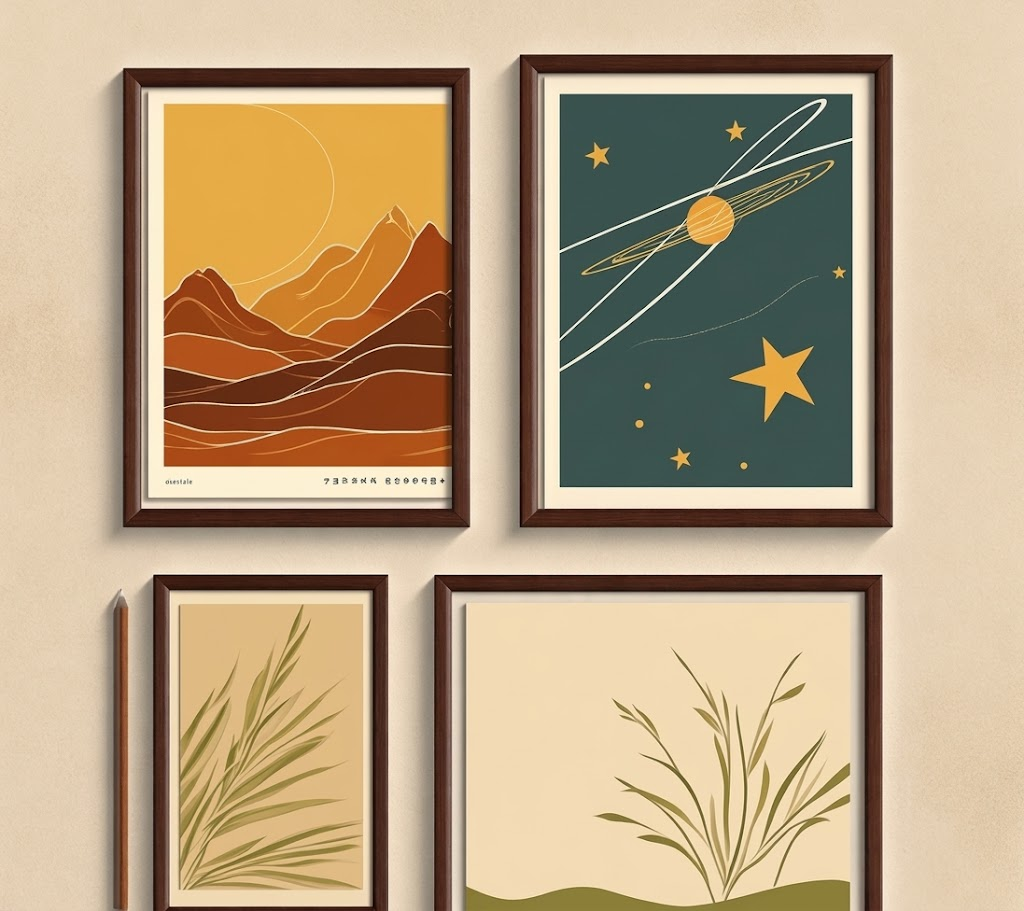
In 2026, searches for vintage wall art grew +350% year over year, making it one of the fastest-growing keywords in the wall decor category. The surge is not a short-lived social media spike. It is being driven by three structural forces: a backlash against algorithm-driven sameness, the mainstream return of maximalism and eclecticism, and a shift in buyer search behavior toward highly specific long-tail queries.
The +350% Signal Is Not a Standalone Spike
To understand the 350% increase, it helps to look at the broader wall art market. The global wall art market is estimated at $63.67 billion in 2026, growing at a CAGR of roughly 7%, with some long-range forecasts projecting 9.39% CAGR from 2026 to 2034. Vintage and retro are consistently listed among the core style segments in wall art market reports, alongside minimalism, industrial, and bohemian.
More specific signals point in the same direction. The global vintage wall art segment is estimated at more than £2.5 billion annually, with vintage decor searches growing at 15%–20% year over year. On platforms such as Etsy, the category is dominated by hundreds of small shops rather than a handful of giants. That makes it highly fragmented, easy to enter, but difficult to rank for with generic positioning.
The 350% figure matters because it is happening on top of a mature, steadily growing category. This is not a zero-to-one base effect. It is a rapid shift in demand structure inside an already established market.
Why 2026: Two Structural Drivers
Driver 1: Aesthetic Fatigue and Anti-Algorithm Sentiment
In February 2026, a study from the American Psychological Association produced a key data point: 68% of people aged 18–29 said they were experiencing “aesthetic fatigue” after prolonged exposure to algorithm-optimized content and spaces. Airbnbs look the same. Coffee shops have the same Edison bulbs. Apartments have the same white walls and black-framed prints.
Vintage wall art — especially pieces with visible handcraft, period texture, and “imperfect” detail — offers a direct response to that sameness. This explains why the fastest-growing searches are not for vaguely “old-looking art,” but for decade-specific vintage styles. Gen Z is rediscovering 70s and 80s aesthetics through social media, while millennials continue to drive Mid-Century Modern demand. Broad “shabby chic” interest is declining, while combinations of decade + room + palette are rising.
Driver 2: Maximalism and Eclecticism Are Back
1stDibs’ ninth annual designer survey, published in November 2025 with 468 global professionals, found that 39% of designers named maximalism as the most sought-after style for 2026, while 38% chose eclecticism. Maximalism’s share has climbed steadily from 34% in 2023. Pinterest data confirms the same shift on the consumer side: “eclectic apartment” searches are up +630%, “vintage maximalism” +260%, and “eclectic maximalism” +215%.
Vintage wall art is one of the most natural carriers for maximalist and eclectic interiors. It does not require buyers to throw out what they already own. It asks them to layer different eras, materials, and sizes into a personal narrative. That “works with what you already have” quality lowers both the decision barrier and the action cost.

What Buyers Actually Search For
The 350% increase only becomes useful when it is translated into actual search behavior. High-converting searches in this category are clearly long-tail, scene-specific, and decade-specific.
The high-intent query, decoded
Buyers complete a three-part mental filter long before they reach a listing.
Typical high-intent queries include: “70s sun aesthetic print,” “Art Deco bathroom poster,” “mid-century modern kitchen wall art,” and “80s neon grid poster.” A generic “vintage wall art” listing struggles to match those intents. A listing whose title and description clearly say “1970s sunburst print for bathroom” or “Art Deco inspired gallery set for entryway” has a much shorter conversion path.
Cross-border SEO research repeatedly confirms the same pattern: scene-specific terms are more valuable than generic terms. Long-tail queries for bathrooms, entryways, kitchens, dorms, and home offices have significantly lower competition than broad terms such as “living room wall art,” and the more specific the search, the clearer the purchase intent. Google and Etsy data support this: 72% of buyers search Google for a specific product before purchasing, and 38% eventually complete the transaction on Etsy. Vintage and niche-design buyers conduct Google research 2.8 times more often than fast-fashion buyers.
Four Vintage Wall Art Sub-Niches That Work in 2026

| Sub-niche | Why it works in 2026 | Best-fit rooms |
|---|---|---|
| Grandmillennial / Cottagecore floral and botanical prints | Delivers pre-digital warmth, visual complexity, and a deliberate break from minimalism. | BedroomsLiving roomsSunroomsEntryways |
| Dark Academia / dark botanical and blueprint art | Rides the “gloomy aesthetic” and archive-like knowledge trend. | Home officesStudiesEntryways |
| Decade-specific travel posters and graphic design | Buyers want decade accuracy, not generic retro styling. | KitchensHallwaysDormsOffices |
| Diptychs and multi-panel vintage sets | Raises average order value and offers a ready-to-hang solution. | Living roomsBathroomsStairwells |
Catalogue 01 — Four viable sub-niches, ranked by search intent
01 Grandmillennial and Cottagecore Floral and Botanical Prints
This is the most emotionally driven sub-segment inside the 350% increase. Grandmillennial style is not simply “grandma style.” It is a deliberate choice by younger buyers to embrace florals, needlepoint, chinoiserie, and botanical prints, then mix them with contemporary pieces. Buyers want pre-digital warmth, visual complexity, and objects that feel like they have a history — not Instagram-friendly minimalism. Floral wall art searches are also growing strongly, creating a compounding effect with the vintage direction.
02 Dark Academia, Dark Botanical, and Blueprint Art
As 2026 wall art moves from “sterile minimalism” toward “vibrant maximalism and gloomy aesthetic,” dark-background botanical prints (William Morris style, Dark Academia) and architectural blueprints or diagrams are clear rising sub-categories. Their overlap with vintage wall art is obvious: they carry an “old-world knowledge” and archive-like quality that suits studies, home offices, and entryways.
03 Decade-Specific Vintage Travel Posters and Graphic Design
Vintage travel posters, old maps, and retro advertising layouts are long-standing evergreen segments. What has changed in 2026 is the buyer’s demand for decade accuracy. Generic “retro poster” searches are giving way to highly qualified terms such as “1970s National Parks poster” and “1950s atomic age kitchen print.” For print-on-demand and digital download models, this direction is relatively scalable.
04 Diptychs and Multi-Panel Vintage Sets
Vintage style continues to strengthen in POD wall decor, and diptychs and multi-panel sets are a key format for raising average order value. Buyers no longer want a single piece. They want a ready-to-hang combination: a matching vintage botanical triptych for a bathroom, or a mixed-decade gallery set for a living room. Offering room-scene bundles is an effective way to differentiate from single-print sellers.
SEO and Product Playbook
Keyword Strategy: Abandon Head Terms, Own the Long Tail
Generic terms such as “wall art” and “canvas prints” are firmly controlled by Amazon, Etsy, and large retailers. For new sites or small and mid-sized sellers, competing head-on for those terms has a very low ROI. The effective approach is to build content clusters and product titles around each room (bathroom, entryway, kitchen, dorm, home office) and each decade or style (70s, Art Deco, Mid-Century, Dark Academia, Cottagecore). A 700+ word guide page targeting “vintage bathroom wall art,” with actual product links, is more likely to build topical authority and earn long-tail traffic than a generic “vintage wall art recommendations” post.
Content Structure: 700+ Words, Real H2s, and Room-Scene Context
Search engines have steadily reduced tolerance for thin content. A vintage wall art blog post should use a clear H2 structure covering trend context, style explanations, room-by-room pairing advice, and practical buying guidance. Core keywords and variants should be naturally embedded in titles and body copy, not stuffed. At the product description level, label each piece with decade, style, suitable room, and visual motif — for example, “1970s botanical print / kitchen or sunroom / warm earthy palette.” That directly matches multi-dimensional buyer search habits.
Differentiation: Hyper-Niche + Scene Bundles + Decade Accuracy
A highly fragmented competitive landscape means generic vintage shops struggle to build recognition. Top performers often focus on one very narrow sub-direction — “only 1920s travel posters” or “exclusively 70s psychedelic kitchen art” — and build trust through decade-accurate typography, size variants, and a consistent brand aesthetic. On top of that, offering matching room sets and color customization to fit the buyer’s wall color can further lift conversion and average order value.
Frequently Asked Questions
Q. 01 Is vintage wall art still trending in 2026?
Yes. Vintage wall art searches grew +350% year over year in 2026, and the broader wall art market is growing at roughly 7% CAGR, with some forecasts projecting 9.39% CAGR through 2034. The trend is supported by aesthetic fatigue, maximalism, and long-tail search behavior rather than a single viral moment.
Q. 02 What vintage wall art styles are most popular?
The strongest sub-niches in 2026 include Grandmillennial and Cottagecore floral and botanical prints, Dark Academia and dark botanical art, decade-specific travel posters and graphic design, and multi-panel vintage gallery sets. Decade accuracy matters more than generic “retro” positioning.
Q. 03 How should sellers optimize vintage wall art listings?
Sellers should abandon broad head terms and target long-tail queries that combine decade + room + visual direction, such as “70s sun aesthetic print” or “Art Deco bathroom poster.” Product titles and descriptions should explicitly state the decade, style, room, and motif. Content should use a clear H2 structure, run 700+ words, and include room-scene pairing advice.
Q. 04 What rooms work best with vintage wall art?
Bathrooms, entryways, kitchens, home offices, dorms, and living rooms all perform well. The key is to match the decade and visual motif to the room context — for example, warm 70s botanical prints for kitchens and sunrooms, or Art Deco sets for entryways and bathrooms.
Conclusion
The +350% growth in vintage wall art is not a one-off trend pulse. It is the intersection of three structural forces — aesthetic fatigue, the return of maximalism, and the long-tailization of search behavior — inside the wall decor category. The biggest opportunity is not simply “selling vintage prints.” It is becoming the default answer for a specific decade × room × visual direction. Generic vintage wall art is a crowded red ocean. Highly specific vintage wall art remains one of the clearest supply-demand gaps in 2026.