Stainless steel doesn’t guarantee dimensional stability. Poor machining, forming, welding, or heat treatment can cause warping and tolerance loss — often overlooked until the parts arrive.
- 1. Why can stainless steel parts still warp?
- 2. What heat treatment actually does for stainless steel
- 3. Annealing vs. tempering vs. stress relieving
- 4. Why heat treatment sometimes causes more deformation
- 5. What buyers should check when sourcing from China
- 6. Why the right China sourcing partner matters
1. Why Can Stainless Steel Parts Still Warp?
Stainless steel is valued for its corrosion resistance, strength, and durability. However, these properties do not make it immune to deformation.
During manufacturing, metal parts experience different types of mechanical and thermal stress. Common sources include:
- CNC machining: Removing material changes the balance of internal stresses within a component.
- Cold forming: Bending, stamping, and pressing can introduce residual stress.
- Welding: Uneven heating and cooling can create localized expansion and contraction.
- Cutting and grinding: Localized heat and mechanical force can affect dimensional stability.
These stresses may remain inside the material even when the component appears completely normal. The problem becomes more noticeable when the part undergoes additional machining, assembly, or temperature changes.
For example, imagine a stainless steel bracket with several precisely positioned mounting holes. After machining, its dimensions appear correct. However, once the material is released from its fixture, internal stresses may redistribute, causing slight bending. The result? The holes may no longer align correctly, the mounting surface may become uneven, or the component may fail to fit its matching parts.
2. What Heat Treatment Actually Does for Stainless Steel
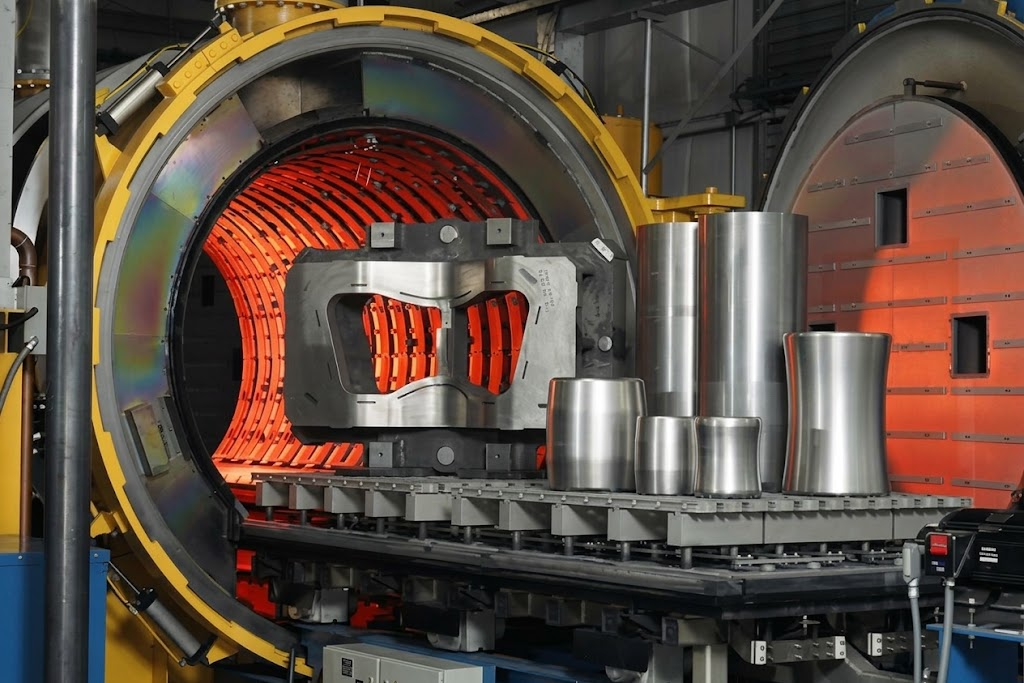
Heat treatment is a controlled process of heating and cooling metal to achieve specific material properties. Depending on the stainless steel grade and manufacturing requirements, it can help:
- Reduce residual stress.
- Restore ductility after cold working.
- Adjust hardness and mechanical properties.
- Improve dimensional stability.
- Restore corrosion resistance after certain manufacturing processes.
However, not every stainless steel component requires the same treatment. The correct process depends on the material composition, part geometry, previous manufacturing operations, and final application. Three processes are particularly important when discussing stainless steel hardware.

A. Annealing: Restoring Material Properties
Annealing involves heating metal to a specified temperature, holding it for a controlled period, and cooling it according to the material and process requirements. For many austenitic stainless steels, such as 304 and 316, solution annealing helps dissolve unwanted precipitates, restore the material’s structure after cold working, and improve corrosion resistance. It can also reduce residual stresses introduced during forming or machining.
However, solution annealing is not simply a matter of heating a component and allowing it to cool naturally. Temperature, holding time, and cooling rate all matter. For certain stainless steel grades, rapid cooling is necessary to avoid harmful precipitation during cooling.
B. Stress Relieving: Reducing Internal Stress
Stress relieving aims to reduce residual stresses that develop during machining, welding, forming, or other manufacturing operations. This process can be particularly useful for complex hardware components where dimensional stability is important. For example, a machined stainless steel mounting plate may experience internal stress after substantial material removal. A properly selected stress-relief process can reduce the risk of further distortion during subsequent machining or service.
However, stress relieving must be selected carefully. For austenitic stainless steels, certain temperature ranges can increase the risk of sensitization or unwanted phase precipitation. A treatment that reduces stress but compromises corrosion resistance is not a good manufacturing solution.
C. Tempering: Improving the Properties of Hardened Steel
Tempering is often confused with annealing and stress relieving, but they serve different purposes. Tempering is commonly used after hardening martensitic stainless steel. It involves reheating hardened steel to a controlled temperature below its critical transformation range, holding it, and cooling it to adjust hardness, toughness, and internal stress. For example, certain martensitic stainless steel grades used in cutting components, shafts, and wear-resistant hardware require a carefully controlled hardening and tempering process.
3. Annealing vs. Tempering vs. Stress Relieving
For buyers sourcing stainless steel hardware, understanding these differences makes supplier discussions much more effective.
| Process | Main Purpose | Typical Application |
|---|---|---|
| Annealing | Restore ductility and material structure | Formed or heavily worked stainless steel |
| Stress relieving | Reduce residual internal stress | Machined or welded components |
| Tempering | Adjust hardness and toughness after hardening | Martensitic stainless steel parts |
These processes are not interchangeable. A factory should not recommend heat treatment simply because a buyer reports that a component is bending. The first step should be identifying the material grade, manufacturing history, and actual cause of deformation. In some cases, stress relieving may be appropriate. In others, the problem may be caused by poor machining sequences, uneven material removal, unsuitable fixtures, or inconsistent cooling. Heat treatment alone cannot solve every dimensional problem.
4. Why Does Heat Treatment Sometimes Cause More Deformation?
Here is an important detail that buyers should understand: heat treatment can reduce internal stress, but it can also introduce new dimensional changes if the process is poorly controlled. Several factors can contribute to metal part warping during heat treatment.
Uneven Heating
If different sections of a component heat up at different rates, thermal expansion may become uneven. Thin sections may respond faster than thick sections, creating temporary differences in temperature and stress.
Improper Cooling
Cooling too quickly, too slowly, or unevenly can affect the final structure and dimensions of certain stainless steel grades. The correct cooling method depends on the material and treatment.
Poor Part Positioning
How components are placed inside a furnace also matters. Long, thin, or asymmetrical parts may bend under their own weight or experience uneven support during heating.
Incorrect Temperature or Holding Time
Excessive temperature or holding time can affect grain structure and mechanical properties. Insufficient treatment may also fail to achieve the intended result.
5. What Should Buyers Check When Sourcing Hardware Parts from China?
When working with Chinese hardware manufacturers, buyers should look beyond material certificates and finished product appearance. A more effective sourcing process starts with understanding how the component is manufactured. Here are five questions worth asking your supplier.
| Question to ask your supplier | Why it matters |
|---|---|
| What is the exact stainless steel grade? | Do not accept a general description such as “stainless steel material.” Confirm whether the component uses 201, 304, 316, 430, 410, or another grade — different grades respond differently to heat treatment. |
| What manufacturing processes are involved? | Ask whether the part requires CNC machining, stamping, bending, welding, or multiple processing stages. More complex sequences may introduce additional residual stress. |
| Is heat treatment necessary for this component? | Ask the factory to explain whether annealing, stress relieving, or another process is required. The answer should be based on the material and application, not a standard treatment applied to every product. |
| How does the factory control dimensional changes? | Ask whether critical dimensions are measured before and after heat treatment. For precision hardware, checking flatness, hole positions, thickness, and overall dimensions helps identify process-related changes. |
| Can the supplier provide process records? | For components with strict technical requirements, request relevant heat treatment records, material documentation, and dimensional inspection results to verify consistency across batches. |

6. Why the Right China Sourcing Partner Matters for Metal Hardware
Finding a factory that can manufacture a stainless steel component is only the beginning. For overseas brands, the bigger challenge is ensuring that the material, manufacturing process, and final specifications work together. A supplier may offer an attractive quotation and promise to produce the required dimensions. However, if the manufacturing process is not properly evaluated, problems may only become visible after the products arrive.

This is particularly important for hardware parts involving:
- Precision-machined metal components.
- Stainless steel brackets and mounting accessories.
- Metal connectors and fasteners.
- Custom metal fittings.
- Components requiring multiple machining or forming operations.
At JackHoo Sourcing, we believe effective China sourcing should go beyond finding a factory and comparing prices. We focus on understanding product requirements, identifying suitable manufacturing resources, and paying attention to the details that influence the final product. For technical hardware projects, this means considering material specifications, production methods, dimensional requirements, and supplier capabilities before moving forward with an order. The goal is simple: help brands make better sourcing decisions and reduce avoidable production risks.
Want a free supply chain consultation?
FAQs: Warping, 304 Grades & Annealing vs Tempering
Why do stainless steel parts warp after machining?
Machining removes material and can redistribute residual stresses within the component. If the stress is uneven, the part may bend or twist after machining or when released from its fixture.
Does 304 stainless steel need heat treatment?
Not every 304 stainless steel component requires heat treatment. However, heavily cold-worked, welded, or precision-machined parts may require a suitable treatment depending on their application and dimensional requirements.
What is the difference between annealing and tempering?
Annealing generally restores ductility and material structure, while tempering adjusts hardness and toughness after hardening. They are different processes used for different material conditions.
Can heat treatment prevent all metal part deformation?
No. Heat treatment can help reduce certain residual stresses, but deformation can also result from poor machining methods, unsuitable fixtures, uneven cooling, and incorrect material selection.
How can I check whether a Chinese factory has reliable heat treatment capabilities?
Ask about its heat treatment equipment, process parameters, material experience, temperature controls, and dimensional inspection procedures. For critical components, request relevant process records and before-and-after measurement results.