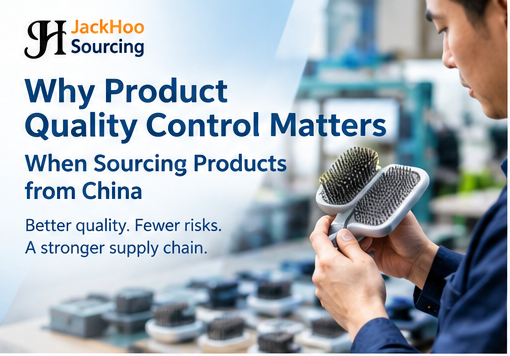
When sourcing products from China, price, production capacity, and delivery time are often the first things businesses consider.
But there is another factor that can have an even greater impact on your business: product quality control.
For e-commerce brands managing multiple products, suppliers, or production orders, quality problems can become expensive when they are discovered too late. A manufacturing defect, inconsistent batch, incorrect packaging, or specification error may not become obvious until the products have already left the factory.
By then, fixing the problem can be difficult and costly.
That is why effective quality control in China should not be treated as a single inspection before shipment. It should be a continuous process throughout production.
Why Quality Problems Become Expensive
A quality issue discovered before production is relatively easy to correct.
The same issue discovered after production can be much more expensive.
For example, an e-commerce brand may face:
Production delays
Rework or replacement costs
Shipping delays
Incorrect packaging or labeling
Product returns
Negative customer reviews
Increased after-sales costs
Inventory that cannot be sold as planned
For companies managing multiple brands or a large number of SKUs, these problems can become even more complicated because several factories and suppliers may be involved at the same time.
The earlier a problem is identified, the more options a buyer has to correct it.
Quality Control Should Start Before Production
Effective supplier quality control begins before a factory starts mass production.
1. Factory & Supplier Verification
Before placing an order, it is important to understand who is actually producing the product.
Supplier verification can include reviewing:
Factory capabilities
Production facilities
Relevant product experience
Quality management procedures
Production capacity
Previous production performance
Choosing the right supplier is the first step in reducing quality risks.
2.Pre-Production Inspection

Before mass production begins, specifications should be clearly confirmed.
This can include checking:
Approved samples
Product dimensions
Materials
Colors
Functional requirements
Components and accessories
Packaging requirements
Labeling specifications
A clear pre-production standard gives both the buyer and factory the same reference point.
3. During-Production Inspection

One of the most valuable parts of product quality control is checking products while production is still underway.
Instead of waiting until everything is finished, inspections can identify problems while there is still time to correct them.
For example, inspections may identify:
Material inconsistencies
Assembly problems
Incorrect dimensions
Surface defects
Functional issues
Color differences
Production deviations
If a problem is discovered early, the factory may be able to adjust the production process before the entire order is affected.
This can significantly reduce the potential cost of quality issues.
4.Pre-Shipment Inspection
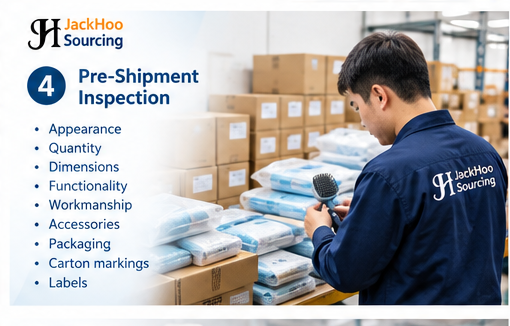
Before products leave the factory, a final inspection provides another important quality checkpoint.
The finished products can be checked against the approved specifications, samples, and quality requirements.
Depending on the product, this may include checking:
Appearance
Quantity
Dimensions
Functionality
Workmanship
Accessories
Packaging
Carton markings
Labels
The objective is not simply to find defects.
The objective is to make sure the products being shipped are consistent with
what was approved before production.
5.Packaging and Labeling Checks

Product quality does not stop with the product itself.
Incorrect packaging or labeling can create problems during transportation, customs clearance, warehousing, and final delivery.
A quality control process should therefore also verify:
Product packaging
Carton specifications
Shipping marks
Product labels
Barcode information
Instruction manuals
Required warnings or compliance information
These details may seem small, but mistakes across thousands of units can create significant operational costs.
6.Issue Tracking and Corrective Actions
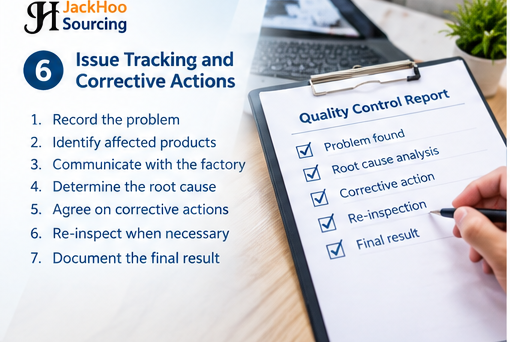
Finding a problem is only part of quality control.
The next step is understanding why the problem happened and how it can be prevented from happening again.
When an issue is identified, a structured process can be used to:
Record the problem
Identify the affected products or production batch
Communicate the issue with the factory
Determine the root cause
Agree on corrective actions
Re-inspect when necessary
Document the final result
This creates a more consistent quality management process across different suppliers and orders.
Why Local Quality Control Matters When Sourcing from China
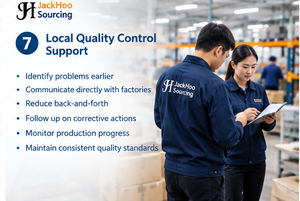
For overseas companies sourcing from China, managing quality remotely can be challenging.
Time-zone differences, language barriers, factory communication, and physical distance can make it difficult to respond quickly when a production issue occurs.
Having a local China sourcing and quality control team can provide an additional layer of support.
Instead of relying entirely on photos, videos, or factory reports, a local team can communicate directly with suppliers and conduct on-site inspections when required.
This can help businesses:
Identify problems earlier
Communicate directly with factories
Reduce unnecessary back-and-forth
Follow up on corrective actions
Monitor production progress
Maintain consistent quality standards
For companies managing multiple e-commerce brands, this local support can also reduce the operational workload placed on internal purchasing and supply chain teams.
Quality Control Is More Than a Final Inspection
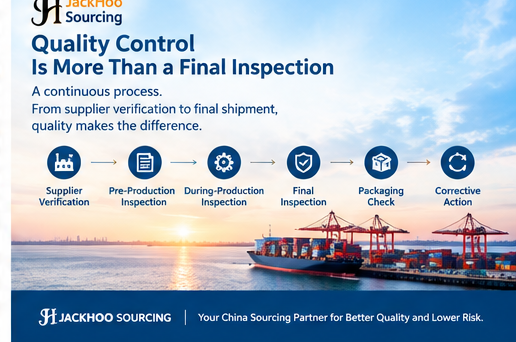
A common mistake is to think of quality control as something that happens only when an order is finished.
In reality, effective supplier quality control is a process that starts before production and continues until the products are ready to ship.
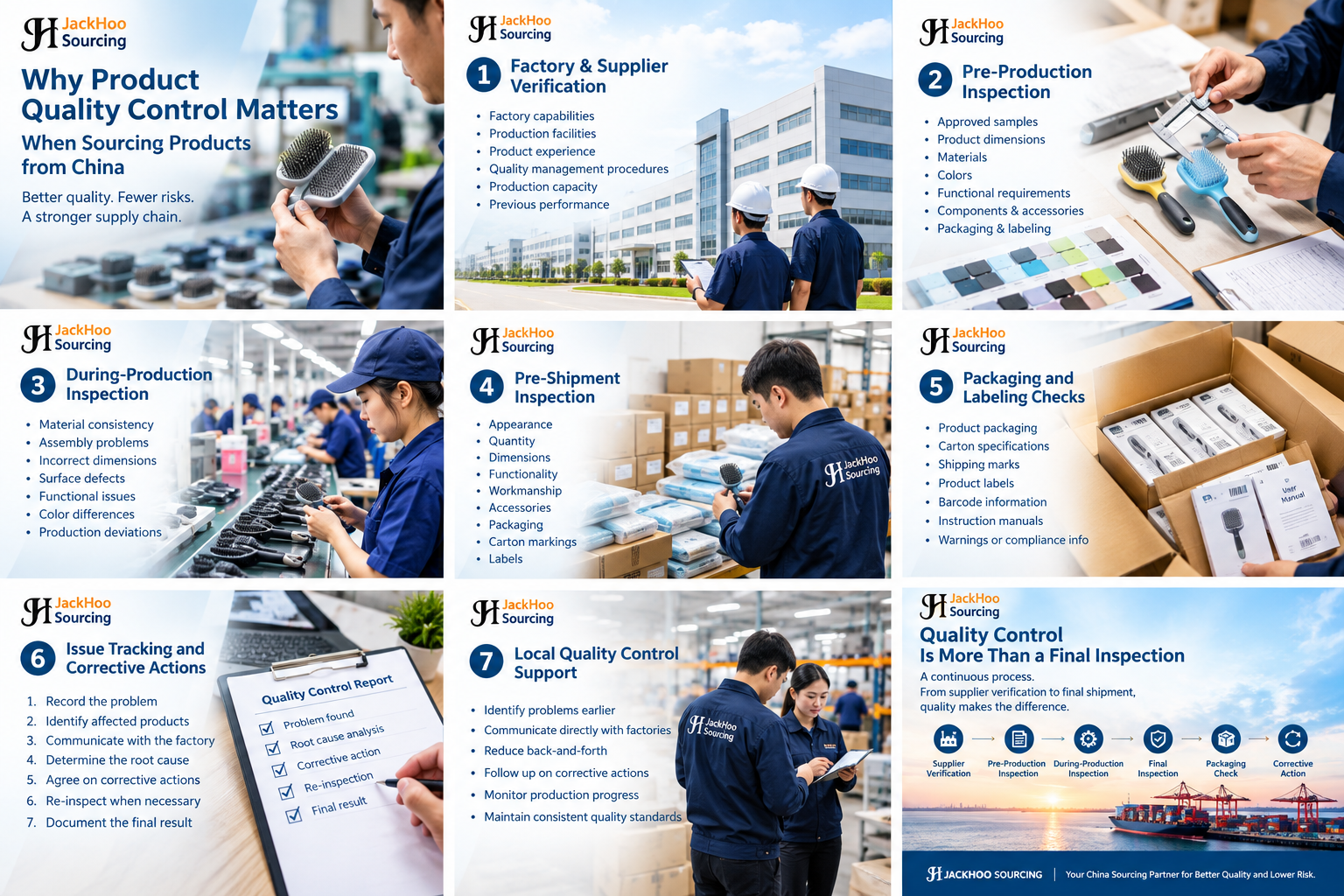
A simple way to look at the process is:
Supplier Verification → Pre-Production Inspection → During-Production Inspection → Final Inspection → Packaging Check → Corrective Action
Each stage provides an opportunity to identify and resolve problems before they become more expensive.
The Goal: Fewer Surprises Before Shipment
Quality control cannot eliminate every possible production problem.
But a well-managed QC process can help identify problems earlier, when they are generally easier and less expensive to address.
For businesses sourcing from China, the goal is not simply to find the lowest factory price.
It is to build a supply chain where quality, specifications, production, packaging, and delivery are properly managed from beginning to end.
When quality is monitored throughout the production process, businesses can have greater confidence that the products leaving the factory match the products they approved.
If you are sourcing products from China and looking for more reliable supplier and quality control support, JACKHOO SOURCING can help you manage the process directly from the China side.