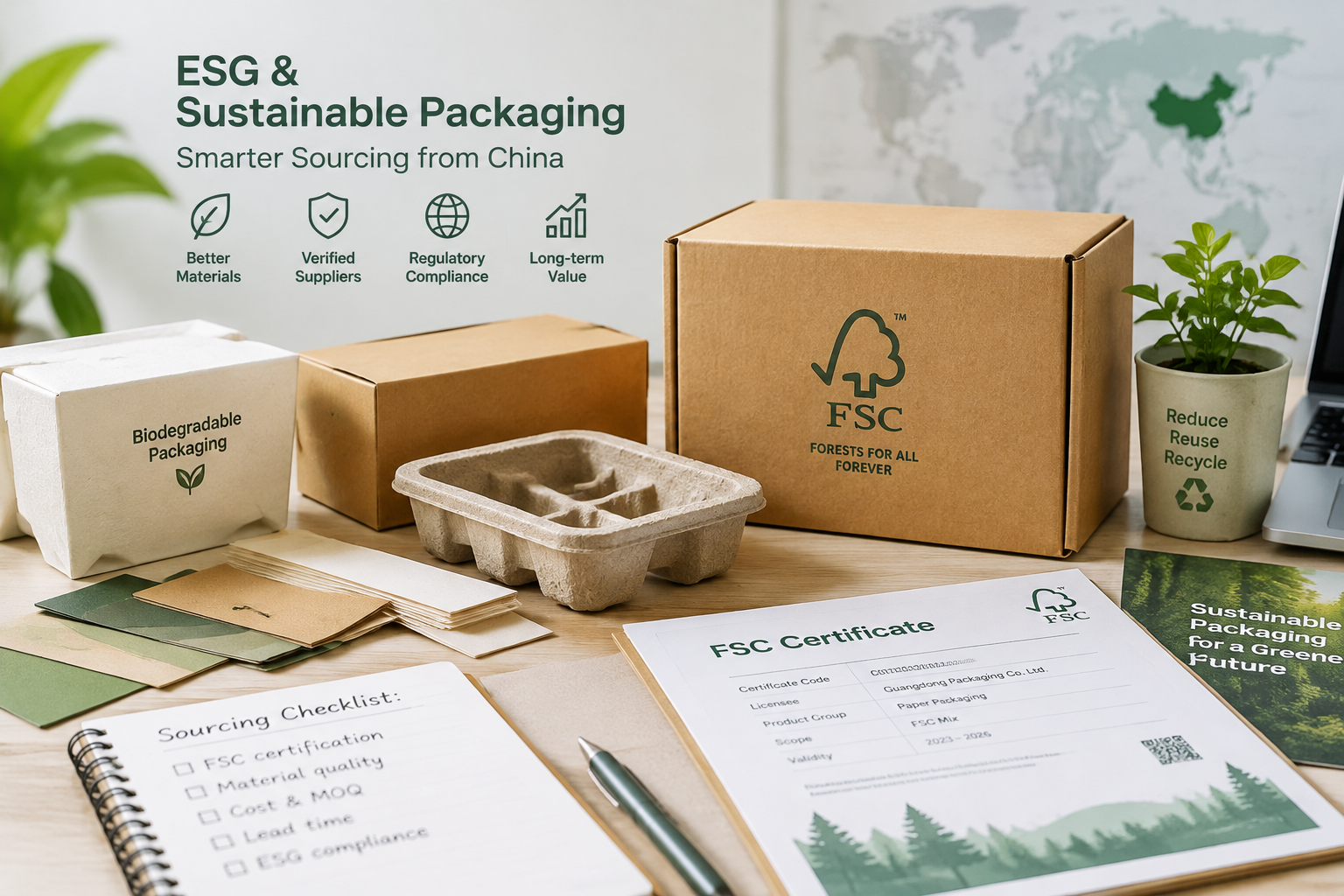
Green claims and inconsistent suppliers can quietly eat into your margins. Let's walk through how to source truly sustainable packaging from China that meets compliance without inflating your costs.
Why ESG and Sustainable Packaging Matter to International Brands
Environmental, Social, and Governance (ESG) considerations influence how businesses evaluate their supply chains, suppliers, and long-term operating risks.
Packaging is an important part of this process because it connects several business concerns:
Environmental impact
Packaging choices influence the amount of material used, the resources required to produce it, and the options available when it becomes waste.
⚠️ Increases impact
- Excessive packaging raises material consumption and shipping volume.
- Several permanently bonded materials are difficult to separate for recycling.
✅ Reduces impact
- Reduce unnecessary layers.
- Select materials compatible with established recycling systems.
- Use verified recycled content or responsibly sourced paper.
However, no single material is automatically the best environmental choice in every situation. The product's weight, fragility, transportation route, intended use, and local waste infrastructure all matter.
Regulatory and compliance considerations
Environmental expectations are increasingly reflected in packaging legislation and customer requirements.
The European Union's Packaging and Packaging Waste Regulation (PPWR) establishes a common framework covering packaging placed on the EU market, including requirements relating to packaging design, waste prevention, recyclability, and other aspects of packaging performance.
The precise obligations and implementation timelines differ by requirement, so brands should check which rules apply to their products, packaging formats, and role in the supply chain.
Brand trust and customer expectations
Sustainability can also influence how customers perceive a brand.
Consider two products with similar features and prices:
🟢 Product A
- Correctly sized carton
- Minimal unnecessary packaging
- Clear disposal instructions
🔴 Product B
- Oversized box
- Filled with excessive plastic
Product A may communicate greater attention to detail, although actual customer preferences will depend on the market and product category.
For premium brands, sustainable packaging can support product positioning when the materials, design, and claims are credible. It should not be treated as a guaranteed way to increase sales or justify a higher price.
The commercial opportunity comes from combining a better customer experience with measurable improvements in material use, product protection, and supply chain efficiency.
What Does Sustainable Packaging Actually Mean?
Before contacting packaging manufacturers in China, define what sustainability means for your particular product.
Different packaging materials offer different advantages and limitations. A supplier that specializes in paper cartons may not be the right choice for moisture-sensitive products, while a compostable material may not be suitable for a product that requires a long shelf life.
The first step is to distinguish between the main packaging options.
Recyclable paper and cardboard
Paperboard cartons, corrugated shipping boxes, molded fiber inserts, and paper-based protective packaging are common options for brands seeking to reduce unnecessary plastic.
✅ Potential advantages
- Compatibility with established paper recycling systems (depends on construction and local facilities).
- Flexibility in printing, finishing, and structural design.
- Opportunities to reduce packaging weight or unnecessary material.
- Paper available through certified responsible-forestry systems.
⚠️ Watch-outs
- Heavy coatings, plastic laminations, certain adhesives, and mixed materials may complicate recycling.
- Performance limits when exposed to moisture or demanding handling.
- Always ask suppliers about the complete construction: coatings, windows, adhesives, printing treatments, protective layers.
Recycled-content plastic packaging
Plastic may remain necessary for products that require moisture resistance, visibility, flexibility, or durable protection. In these situations, recycled-content plastic may be worth evaluating.
Ask suppliers to identify:
Biodegradable and compostable packaging
Biodegradable packaging materials are often presented as an environmentally friendly alternative to conventional plastics. However, these terms require careful interpretation:
🔬 Biodegradable
A material's ability to break down through biological processes under specified conditions. Rate and extent depend on temperature, moisture, microorganisms, and the surrounding environment.
🌱 Compostable
Materials that meet defined requirements for breakdown and other performance criteria under specified composting conditions.
When evaluating biodegradable packaging materials, ask:
These questions help distinguish verified material performance from broad marketing language.
A practical packaging comparison
| Packaging option | Potential advantages | Main limitations to evaluate |
|---|---|---|
| Recyclable paperboard | Printing flexibility, established paper recycling routes in many markets | Moisture resistance, coatings, mixed materials |
| FSC-certified paper packaging | Documented sourcing claims within the applicable certification scope | Certification must cover the relevant supplier, product, and claim |
| Recycled-content plastic | Can reduce demand for virgin plastic | Recycled-content evidence, material performance, actual recyclability |
| Compostable packaging | May suit specific applications with appropriate collection infrastructure | Required composting conditions, certification, local acceptance |
| Molded fiber packaging | Can replace some plastic inserts and cushioning | Moisture resistance, structural strength, volume, and shipping performance |
| Reduced-material packaging | Can lower material consumption and shipping volume | Must retain sufficient product protection |
The right choice depends on the packaging's function, the target market, and the evidence available to support the environmental claims.
How to Find FSC-Certified Packaging Suppliers in China
For brands using paper or wood-based packaging, FSC certification can be one useful part of a responsible sourcing strategy.
The Forest Stewardship Council (FSC) operates a certification system intended to support responsible forest management and the traceability of forest-based materials through the supply chain.
However, finding a supplier that says it offers FSC paper is not the same as confirming that the packaging you purchase can legitimately carry an FSC claim.
Step 1: Define the packaging you need
Before searching for suppliers, prepare a clear specification.
Include:
This helps suppliers determine whether they can meet your requirements rather than simply offering a generic paper box.
Step 2: Search for manufacturers with relevant certification capabilities
Use targeted searches such as:
B2B marketplaces and industry directories can help you build an initial shortlist. Directories are discovery tools, however, and a supplier profile is not proof of certification.
Step 3: Verify the certificate and its scope
Do not stop after receiving a certificate PDF.
FSC Chain of Custody certification is particularly relevant to organizations involved in processing, manufacturing, or trading forest-based products that make FSC claims.
The exact requirements depend on the transaction and claim being made. A supplier may handle paper from certified sources without being authorized to sell every finished product with an FSC claim.
For this reason, confirm the certification requirements for your specific packaging, including any required documentation and product labeling.
Step 4: Confirm the traceability of your actual order
A valid certificate alone does not establish that every item a supplier sells is FSC-certified.
Ask how the supplier distinguishes certified materials from non-certified materials, records relevant purchases and production volumes, and identifies the products covered by the claim.
For your order, clarify:
The objective is to connect the certification to the actual material and finished packaging you purchase.
Step 5: Approve a sample before mass production
Certification does not replace ordinary packaging evaluation.
For e-commerce brands, test how the packaging performs during handling and transportation. A carton that looks attractive but collapses under pressure may create additional product damage, returns, and waste.
How to Evaluate Biodegradable Packaging Materials in China
China has manufacturers and material suppliers offering various bio-based, biodegradable, and compostable packaging solutions. Their products may differ substantially in composition and performance.
The challenge is not simply finding a supplier that offers these materials. It is identifying a material that performs as required and can support the environmental claims your brand intends to make.
Start with the intended application
Different products have different packaging needs.
For example:
Identify the packaging function before deciding which material to use.
Otherwise, a material substitution may reduce the environmental impact of the packaging itself but increase product damage or returns.
Request technical documentation
When evaluating a biodegradable or compostable packaging supplier, ask for documentation that identifies the material composition and substantiates the exact claims being made.
Depending on the material and application, relevant evidence may include:
Check whether the evidence applies to the finished packaging or only to one ingredient.
For example, a supplier may provide a test report for a raw resin, while the final package contains additional materials that affect its performance. The two should not automatically be treated as equivalent.
Ask about real disposal conditions
A material's laboratory performance is only part of the practical picture.
If a package requires industrial composting, determine whether that disposal route is available to your customers. If the package is intended for recycling, verify that its construction is compatible with the relevant recycling system.
Do not use phrases such as “breaks down anywhere,” “100% eco-friendly,” or “completely harmless to the environment” unless the claim is precise, adequately supported, and appropriate under applicable rules.
For brands selling into Europe, environmental claims should be reviewed against current consumer-protection and packaging requirements.
Conduct performance testing
Before placing a production order, evaluate the packaging under realistic conditions.
Consider:
For products with specialized safety or contact requirements, obtain the appropriate technical assessment before approving the material.
A packaging solution should meet both its functional requirements and its substantiated environmental objectives.
How to Assess Eco-Friendly Sourcing Compliance
Environmental sourcing is more reliable when requirements are translated into documents, specifications, and approval steps.
For overseas brands working with Chinese suppliers, the first task is to identify the requirements that apply to the product and market.
Understand the relevant market requirements
For products sold in the European Union, PPWR is a central regulation to review.
Its scope covers packaging and packaging waste across materials and supply-chain origins. The regulation includes provisions relating to packaging composition, waste prevention, recyclability, recycled content, and other requirements, with different provisions applying on different timelines.
Not every requirement applies in the same way to every packaging format or business. Brands should identify their role in the supply chain and obtain appropriate regulatory advice when necessary.
Other markets may have different packaging, recycling, labeling, producer-responsibility, and environmental-claim requirements.
Avoid assuming that a packaging specification developed for one country automatically meets the requirements of another.
Create a packaging compliance file
For each packaging type, maintain a file containing the relevant specifications and supporting evidence.
A practical file may include:
| Document or record | Purpose |
|---|---|
| Approved packaging specification | Defines dimensions, materials, components, and performance requirements |
| Supplier and manufacturer details | Identifies the organization responsible for production |
| Material technical data | Documents composition and relevant properties |
| Certification records | Supports applicable claims, such as FSC certification |
| Test reports | Provides evidence of specified performance or material claims |
| Artwork and labeling approval | Controls environmental wording, symbols, and product information |
| Purchase and batch records | Helps connect the approved requirements to actual orders |
| Change-control records | Documents changes to materials, suppliers, and packaging construction |
The exact documents required depend on the packaging and the relevant regulations. This checklist is a practical sourcing tool, not a substitute for a product-specific legal assessment.
Control changes after approval
A common sourcing risk: a supplier changes materials, subcontractors, coatings, or packaging components after a sample has been approved. Even if the new material looks similar, its performance or certification status may differ.
Include a requirement in your purchasing process that material or construction changes must be disclosed and approved before implementation.
Be careful with environmental claims
These common claims communicate different things—each must match the evidence available:
For example, if a carton contains a verified proportion of recycled material, document the percentage and the basis of the claim. If packaging is recyclable only through a specific collection system, avoid implying that it can be recycled everywhere.
Credible environmental communication begins with evidence—not with a label added to the package.
How to Balance Sustainable Packaging with Cost Efficiency
One reason brands hesitate to change packaging is the concern that environmentally preferable materials will increase costs.
The concern is reasonable, but comparing unit prices alone can lead to the wrong decision.
A useful sourcing comparison should include the total cost of the packaging and its effect on the wider supply chain.
Compare the total packaging cost
Request quotations for the existing packaging and the proposed alternative.
Where possible, compare equivalent specifications and order quantities. A price comparison is not meaningful if one quotation includes printing, inserts, and delivery preparation while another excludes them.
Consider the following cost categories:
These factors help establish whether a proposed change creates genuine value for the business.
Example: Comparing two packaging options
The following figures are illustrative only. They are not market quotations or typical industry prices.
| Cost factor | Existing packaging | Proposed alternative |
|---|---|---|
| Packaging unit cost | $0.42 | $0.48 |
| Packaging quantity | 5,000 units | 5,000 units |
| Total packaging purchase | $2,100 | $2,400 |
| Additional testing and setup | $0 | $150 |
| Initial total | $2,100 | $2,550 |
In this example, the alternative requires an additional initial investment of $450.
That does not automatically make it the wrong choice. The next step is to determine whether the new packaging meets the required environmental and performance specifications and whether it offers other measurable benefits.
For example, a redesigned carton might reduce shipping volume, improve packing efficiency, or lower product damage. Those outcomes should be tested and quantified rather than assumed.
The decision should be based on the full commercial and operational picture—not solely on whether the packaging unit price is higher.
Reduce material use before switching materials
One practical approach is to review the existing packaging design before selecting a completely new material.
Ask the supplier whether it is possible to:
These changes may reduce material consumption and shipping volume while maintaining adequate protection.
However, any reduction should be validated through appropriate testing. Removing too much cushioning or structural support can increase damage and waste elsewhere in the supply chain.
Request quotations at several quantities
When a packaging change requires a new setup, tooling, or custom printing, the order quantity can materially affect the unit economics.
Ask the supplier to quote several realistic quantities, such as an initial order and expected replenishment volumes.
Clarify which costs are one-time charges and which recur with every order.
This helps you compare the initial cost of adopting a new packaging solution with the expected cost of maintaining it over time.
The goal is not to select the cheapest material. It is to find a packaging solution that meets the necessary requirements at a commercially sustainable cost.
How to Audit and Compare Sustainable Packaging Suppliers in China
A supplier's environmental claims are only one part of the evaluation. You also need to understand its manufacturing capabilities, quality controls, documentation, and ability to maintain consistent specifications.
A structured supplier assessment can help you compare potential partners.
Check the supplier's actual role
Determine which of these roles the company actually plays:
None of these arrangements is automatically unsuitable. However, you need to know which organization controls the relevant process and where the required evidence originates.
If several factories are involved, identify who is responsible for material purchasing, printing, finishing, testing, and final inspection.
Evaluate documentation and traceability
Ask suppliers to explain:
If a supplier cannot explain how a claim is supported, treat that as a reason for further investigation.
If a supplier cannot explain how a claim is supported, treat that as a reason for further investigation.
Evaluate quality consistency
Request samples and confirm the production specifications before approving the order.
Depending on the packaging, inspection criteria may include:
For important packaging projects, agree on how defects will be handled and how changes will be documented.
Use a practical supplier scorecard
The following scorecard is an example that you can adapt to your own purchasing priorities.
| Evaluation category | Suggested weight |
|---|---|
| Material and claim documentation | 25% |
| Product quality and consistency | 25% |
| Total cost and quantity flexibility | 20% |
| Manufacturing capability and lead time | 15% |
| Communication and change control | 15% |
| Total | 100% |
These weights are suggested starting points, not an industry standard. Adjust them based on the product and market.
For some projects, certification or regulatory documentation may be a mandatory pass-or-fail requirement rather than a category that can be offset by a low price.
A supplier with attractive quotations should not automatically receive approval if it cannot demonstrate the capabilities or documentation required for the project.
Common Mistakes When Sourcing Eco-Friendly Packaging
Even well-intentioned packaging projects can create unnecessary cost or compliance risks when decisions are made too quickly.
Mistake 1: Assuming paper is always more sustainable than plastic
Paper may be appropriate for many applications, but the overall result depends on material sourcing, weight, protective performance, coatings, and disposal options.
Choose packaging based on the product's needs and the relevant environmental objectives rather than a blanket preference for one material.
Mistake 2: Treating biodegradable as a complete environmental claim
A biodegradable material does not necessarily break down quickly under ordinary disposal conditions.
Ask for evidence about the conditions required and whether the final package has been tested. Confirm that the claim accurately describes the material and intended disposal route.
Mistake 3: Trusting a certificate without checking its scope
A supplier may hold a certification that does not cover the particular product or claim you intend to use.
Verify the organization, scope, validity, and documentation requirements. Connect the evidence to the actual packaging order.
Mistake 4: Changing materials without testing the finished package
A new material can affect strength, moisture resistance, printing, assembly, and shipping performance.
Approve samples and test the complete packaging design before committing to mass production.
Mistake 5: Focusing only on the unit price
A lower unit price may come with a larger minimum order, higher setup costs, more storage requirements, or additional waste.
Compare the full cost of purchasing, using, and transporting the packaging.
Mistake 6: Making broad environmental claims without sufficient evidence
Words such as “green,” “eco-friendly,” and “planet-safe” can be too vague to communicate a meaningful, verifiable benefit.
Prefer specific statements that can be supported by documentation, such as a verified recycled-content percentage or a clearly defined certification claim.
Mistake 7: Failing to control supplier changes
An approved material can be replaced with a different grade or composition unless the purchasing process clearly controls substitutions.
Require notification and approval for changes that could affect performance, certification, or environmental claims.
A Practical Roadmap for Implementing Sustainable Packaging in China Sourcing
For brands that have not yet established a formal sustainable packaging process, a phased approach can make the work more manageable.
Phase 1: Review existing packaging
Document the current packaging materials, dimensions, components, costs, and suppliers.
Identify unnecessary layers, excessive empty space, difficult-to-separate materials, and components that could potentially be simplified.
Prioritize the changes most relevant to your product and target market.
Phase 2: Define measurable requirements
Set clear requirements for the proposed packaging.
These may include material composition, recycled content, certification, recyclability, compostability, dimensions, structural strength, and environmental claim documentation.
Separate mandatory requirements from preferences. This helps prevent suppliers from quoting products that look attractive but do not meet the project's actual needs.
Phase 3: Identify and assess suppliers
Build a shortlist of suppliers with relevant manufacturing capabilities.
Request technical documentation, verify certifications where applicable, and compare quotations based on equivalent specifications.
Where possible, evaluate more than one material or design option.

Phase 4: Test and approve samples
Check the finished package for product protection, dimensions, printing, assembly, and relevant material performance.
Document the approved sample and specifications so that the production order can be checked against an agreed reference.
Phase 5: Confirm production and change-control requirements
Before mass production, confirm the supplier's responsibilities, production timeline, quality criteria, required documentation, and process for approving changes.
For projects involving multiple factories, make sure responsibilities are clear and the final packaging specification is consistent across suppliers.
Phase 6: Monitor performance after launch
Track the results of the packaging change.
Useful indicators may include:
- Packaging material used per unit.
- Packaging cost per unit.
- Shipping volume or weight.
- Product damage and return rates.
- Rejection or defect rates.
- Percentage of orders supported by the required documentation.
- Verified recycled content or other defined environmental metrics.
Choose metrics that can be measured consistently and that relate to your actual goals.
A packaging initiative should be reviewed after launch rather than treated as complete when the first production order arrives.
How a China Sourcing Partner Can Support Sustainable Packaging Projects
For overseas brands, finding a packaging supplier is only one part of the process.
A project may involve a product manufacturer, a separate packaging factory, a printing supplier, and a material producer. Each organization may have different capabilities, production schedules, documentation, and minimum order quantities.
Coordinating these suppliers can become challenging when the brand is operating across languages and time zones.

A China sourcing partner can help coordinate the process by:
- Identifying packaging manufacturers based on the required material and design.
- Comparing quotations using consistent specifications.
- Requesting and organizing supplier documentation.
- Helping verify certification details through appropriate official resources.
- Coordinating samples and packaging revisions.
- Following up on production milestones and quality requirements.
- Communicating approved specifications across different suppliers.
- Helping compare packaging cost, material use, and shipping considerations.
The value lies in connecting the different parts of the sourcing process—not simply finding a factory that advertises environmentally friendly packaging.
A sourcing partner cannot automatically guarantee regulatory compliance or certify a material's environmental performance. Those outcomes depend on the applicable requirements, reliable evidence, and the work of appropriately qualified parties.
However, a well-managed sourcing process can help brands identify missing information earlier, reduce avoidable supplier confusion, and make more informed purchasing decisions.
Frequently Asked Questions
How can I find sustainable packaging suppliers in China?
Define the packaging requirements first, then shortlist relevant manufacturers, request technical documentation, verify applicable certifications, and compare samples and quotations before ordering.
How do I verify an FSC-certified packaging supplier?
Use FSC’s official certificate-search resources to check the organization’s identity, status, and scope, then confirm that the specific material and finished packaging can support the intended claim.
Is biodegradable packaging always better than conventional plastic?
No. Performance depends on composition, use, disposal conditions, and local waste infrastructure. Check evidence for the finished package and its intended disposal route.
Is sustainable packaging more expensive?
It can be, but total cost also depends on order quantity, setup, design, and shipping. Compare like-for-like quotations and test proposed changes before assuming savings.
What does the EU PPWR mean for brands sourcing packaging from China?
It establishes EU-wide packaging and packaging-waste requirements with different provisions and timelines. Brands should confirm the obligations that apply to their products and role in the supply chain.
Can a China sourcing partner guarantee compliance?
No. A sourcing partner can help coordinate suppliers, gather evidence, and control specifications, but compliance depends on applicable rules, reliable documentation, and appropriate verification.
The Sustainable Packaging Lab
Four quick challenges: make a call, learn the reasoning, and apply it
🕵️ The Packaging Detective
Choose the best next step for a real-world packaging brief.
🌱 Green Claim or Greenwashing?
Decide whether a claim is supported—or needs more evidence.
🧮 The Packaging Cost Lab
Adjust the assumptions and see the total—not just the unit price.
🔎 Build Your Supplier Scorecard
Check the evidence you have before approving a packaging supplier.
0 / 100
Start by checking the documentation and sample requirements. Some regulatory or certification requirements may be mandatory pass/fail checks, not points that a low price can offset.