You’re thousands of miles away. A polished quote can still hide the wrong legal entity, weak production, or inconsistent quality—and your deposit pays for it. Before you pay, verify the evidence, not the promises. Six practical steps to assess a Chinese supplier with confidence.
Table of Contents
Why Supplier Verification Matters Before You Pay
A low price does not necessarily mean a good deal. The real cost of a supplier includes product quality, communication, production reliability, shipping arrangements, and the time required to resolve problems.
Consider a brand preparing to launch a new grooming tool. One supplier offers a lower unit price but cannot clearly explain its production process. Another provides detailed specifications, consistent sample quality, and a clear production schedule.
The first quotation may look more attractive, but the second supplier may present less risk for a product launch.
This is why supplier verification should happen before a deposit is paid—not after production problems appear.
There are three questions worth answering:
| Core Question | Key Details to Verify |
|---|---|
| Is the company legitimate? | Does the business exist under the legal identity it provides? |
| Can it deliver the order? | Does it have the right products, production arrangements, experience, and quality controls? |
| Can the transaction be verified? | Do the quotation, contract, invoice, and payment details consistently identify the parties involved? |
These questions are connected. A legitimate company may still be unsuitable for a particular order, while a capable factory may not be the right party to handle export documentation or international communication.
Supplier verification is therefore not simply about deciding whether a company is trustworthy. It is about determining whether the company is suitable for your product, order size, quality requirements, and business plans.
Check the Company’s Legal Identity
The first step in learning how to verify a Chinese supplier is confirming which legal entity you are dealing with.
A supplier’s website may display a brand name, while its quotation uses a different company name. This is not automatically suspicious. A brand, trading company, factory, and export company may operate under different names. The important point is understanding the relationship between them.
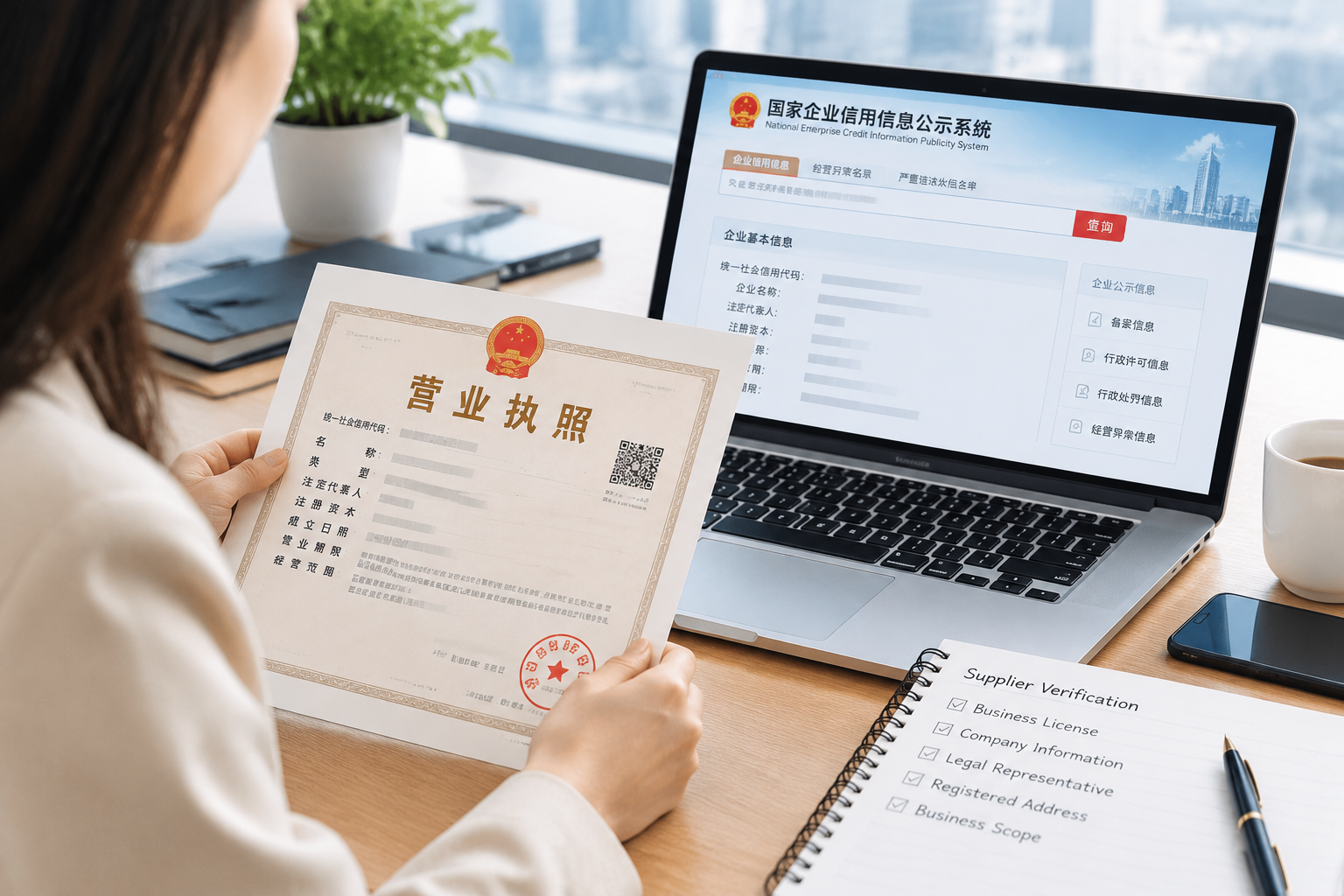
Request the Chinese business license
Ask the supplier for a copy of its Chinese business license, known as a Business License.
Check the following details:
- The registered Chinese company name.
- The Unified Social Credit Code, an 18-character identifier.
- The legal representative.
- The registered address.
- The business registration status and relevant business scope.
Where available, compare these details with China’s National Enterprise Credit Information Publicity System (国家企业信用信息公示系统). Searching the Chinese legal name or Unified Social Credit Code can help you check whether the registration information matches what the supplier has provided.
Do not rely only on an English company name. English translations may vary, so the Chinese legal name is usually more useful when checking official records.
Match the company name across documents
Next, compare the legal entity across the documents relevant to your transaction.
| Document or record | What to check |
| Business license | Legal company name and registration details |
| Quotation | Which company is offering the goods |
| Sales contract | Which entity is legally responsible for the order |
| Commercial invoice | Which entity is billing you |
| Bank account | Who will receive the payment |
| Export documents, when applicable | Which entity is involved in the export transaction |
The names do not always have to be identical. For example, a manufacturer may work with a separate export company. However, the supplier should be able to explain the arrangement clearly, and the relevant contracts and payment instructions should support that explanation.
If the company asks you to transfer money to an unrelated business or an individual’s account, pause and investigate before proceeding.
A verified business registration establishes that a company is registered; it does not, by itself, prove that the company is honest, financially stable, or capable of producing your order. Treat registration as the first checkpoint, not the final decision.
Verify the Factory and Its Production Capabilities
One of the most common questions overseas buyers ask is: Am I dealing with a real manufacturer or a trading company?
The distinction matters, but the answer is not as simple as it may appear.
A manufacturer may offer direct access to production, while a trading company may coordinate several specialized factories and provide a broader range of products. Neither model is automatically better. The more useful question is whether the supplier’s actual role matches your expectations.

Find out who makes the product
Ask the supplier to explain which production processes it handles in-house and which are outsourced.
For a pet grooming tool, for example, the process may involve plastic molding, metal components, assembly, surface finishing, packaging, and final inspection. A supplier may manufacture some components itself while relying on partners for others.
- Which factory will manufacture your product?
- Which processes are completed in-house?
- Are any components or production stages subcontracted?
- Who is responsible for inspecting the finished goods?
- Who will handle production delays or quality problems?
A supplier that openly explains its production arrangements may be easier to assess than one that simply claims to be a factory without providing supporting details.
Check whether its capabilities match your order
A factory’s existence does not automatically mean it is suitable for your product.
A supplier experienced in standard plastic brushes may not have the right expertise for a precision grooming tool with metal components, a specialized coating, or a custom mechanism.
Ask about similar products it has made, available customization options, material specifications, tooling requirements, minimum order quantities (MOQs), and expected production lead times.
If an in-person visit is not possible, arrange a live video walkthrough. Ask the supplier to show the actual production or storage areas, relevant equipment, work-in-progress products, and finished goods. Specific questions about the process are more useful than a general presentation of the showroom.
Remember that a video call provides supporting evidence, not a complete factory audit. When order value, product complexity, or business risk justifies it, an independent on-site audit can provide a more thorough assessment.
Check Samples, Quality Standards, and Certifications
A supplier may have the right business registration and production facilities yet still deliver products that fall short of your expectations.
This is why product verification needs to happen alongside company verification.
Evaluate samples against clear specifications
Request a sample before placing a substantial production order, particularly when developing a new product or changing an existing design.
Avoid evaluating a sample based only on whether it looks good. Define the features that matter to the finished product.
- Material, dimensions, and weight.
- Pin or bristle consistency and finishing.
- Handle strength and grip.
- Sharp edges, loose components, or assembly defects.
- Packaging quality and labeling.
- Performance during normal intended use.
Record your requirements in a specification sheet and document any approved changes. This gives both sides a clearer reference when discussing mass production.
A sample is only one product from one point in time. It does not guarantee that every unit in a bulk order will be identical. For larger or more sensitive orders, consider a defined inspection plan and a pre-shipment inspection before the goods leave the factory.
Understand what certificates actually prove
Certificates can be useful evidence, but their value depends on the product, the destination market, and the specific claim being made.
- Who issued the document.
- Which company or product it identifies.
- Whether the model, material, or product category matches your order.
- Whether the stated scope covers the relevant requirement.
- Whether the document is current, where validity periods apply.
- Whether the issuing organization can confirm its authenticity.
Do not assume that a certificate held by one company automatically covers every product sold by another company. Similarly, a document relating to one product model may not apply to a modified version.
The relevant requirements also depend on the product and its intended market. Confirm applicable obligations rather than asking for certificates simply to collect paperwork.
The strongest evidence comes from connecting the supplier’s identity, the actual product, the approved specifications, and the relevant test or inspection records.
Spot Red Flags Before Sending a Deposit
Not every supplier with incomplete information is fraudulent. Some communication problems can result from language differences, administrative delays, or an unfamiliar export process.
However, certain warning signs deserve closer attention, especially when several appear together.
-
1. The company refuses to provide basic registration details.
A supplier may have legitimate reasons to protect confidential information, but it should generally be able to establish its legal identity before entering a significant commercial transaction.
-
2. Its company information changes between documents.
Different names can have legitimate explanations, but unexplained differences between the company on the quotation, the contracting party, and the payment beneficiary need to be resolved.
-
3. It makes claims that cannot be supported.
Statements such as “we manufacture everything in-house,” “all products meet international standards,” or “we guarantee zero defects” are not substitutes for specific evidence.
-
4. It pressures you to pay immediately.
A short promotional period is not necessarily suspicious. Pressure to bypass normal checks, accept incomplete documentation, or send money before the terms are clear is a more serious concern.
-
5. It avoids clear product specifications.
If a supplier cannot confirm the materials, dimensions, packaging, approved sample, or production schedule, disagreements may arise after the order has been placed.
-
6. It cannot explain its production arrangements.
A supplier that outsources some processes is not automatically unreliable. The concern is an unwillingness or inability to explain who makes the product and who is accountable for quality.
A supplier that outsources some processes is not automatically unreliable. The concern is an unwillingness or inability to explain who makes the product and who is accountable for quality.
What to do when something does not match
Pause the transaction and ask for clarification in writing. Request supporting documents and independently check information that can be verified.
For significant discrepancies, consider a third-party inspection, legal review, or other appropriate professional support before committing funds.
Most importantly, do not let an attractive price or an urgent product launch push the verification process aside. The cost of resolving a preventable problem can be much greater than the time spent checking the supplier beforehand.How to Verify Chinese Suppliers Remotely: A Practical Checklist
Overseas buyers do not always need to travel to China to begin assessing a supplier. A structured remote process can help identify inconsistencies and narrow the options before deciding whether an on-site visit or independent audit is necessary.
The key is to collect evidence in a logical order rather than relying on a website, a video call, or a single document.
A practical supplier verification checklist
| Checkpoint | Action | Evidence to look for |
| Legal identity | Request and check the business license | Matching company registration details |
| Business status | Search official registration records | Consistent legal name and registration information |
| Supplier role | Ask whether it is a manufacturer, trading company, or export partner | Clear explanation of responsibilities |
| Production capability | Review relevant facilities and previous product experience | Evidence of equipment, processes, and suitable capacity |
| Product quality | Request and evaluate a sample | Sample assessed against written specifications |
| Certifications | Check the issuer, scope, and product details | Documents relevant to the specific product and market |
| Transaction details | Review the quotation, contract, invoice, and payment instructions | Clear and explainable relationships between entities |
| Quality control | Agree on inspection criteria before production | Written standards and a defined inspection process |
| Order terms | Confirm MOQ, lead time, packaging, delivery terms, and remedies | Clear written agreement |
| Final decision | Review unresolved issues before paying | No unexplained high-risk discrepancies |
Build an evidence chain, not a folder of documents
The purpose of this checklist is not to accumulate as many files as possible. It is to see whether the information tells a consistent story.
For example, a registered company name should connect logically to the supplier’s quotation and contract. The supplier’s stated production role should match the factory or production partners involved. The approved sample should match the product specifications used for the order. Payment instructions should be consistent with the agreed transaction structure.
When one detail does not match, investigate the relationship rather than immediately assuming wrongdoing—or ignoring the discrepancy.
The verification process should also reflect the size and complexity of the order. A repeat purchase of a familiar, low-risk product may require a different level of investigation from a new custom product involving tooling, significant upfront payments, or strict compliance requirements.
Remote checks can reduce uncertainty, but they cannot eliminate every risk. For a large order or a product with demanding technical requirements, independent audits, inspections, and professional advice may still be worthwhile.
Conclusion: Verify Suppliers, Not Just Prices
Knowing how to verify Chinese suppliers is about more than checking a business license or requesting a sample. It means understanding who you are dealing with, how the product will be made, what evidence supports its quality, and how the commercial transaction will work.
For overseas brands, the right supplier is not necessarily the company with the lowest quotation or the most impressive website. It is the partner whose capabilities, communication, production arrangements, and business terms fit the requirements of the order.
At JackHoo Sourcing, supplier selection is part of a broader process that connects product requirements with sourcing, development, production follow-up, quality control, and shipping arrangements in China. The goal is to help overseas businesses make more informed sourcing decisions and manage the details between a product idea and delivery.
You focus on your brand. We take care of China.
Before placing your next order, take the time to verify the company behind the quotation—and make sure the evidence supports the decision.