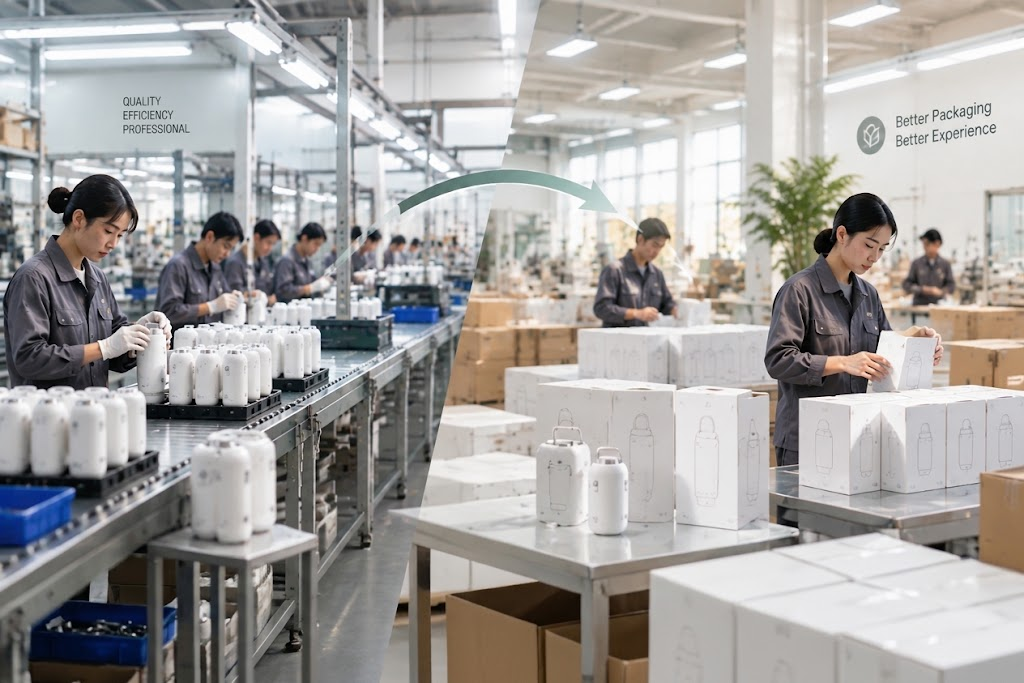
Product ready, packaging promised—then fit issues, extra samples, and label errors delay shipment. In China, product and packaging suppliers work separately, so poor coordination costs time. Align specs, dimensions, approvals, and schedules early. This guide shows how, and how a sourcing partner helps.
Why Product and Packaging Suppliers Fall Out of Sync
A product and its packaging are often developed separately. The product manufacturer focuses on materials, components, assembly, and product performance. The packaging supplier focuses on boxes, inserts, printing, and finishing.
The problem appears when these two workstreams are treated as independent projects.
The problem appears when these two workstreams are treated as independent projects. Here are the most common ways they drift apart:
A box is built from early measurements, but the finished product is larger after a component change.
The product fits the outer box, but the insert does not hold it securely.
An outdated logo, wrong information, or an unapproved barcode gets printed.
Products are ready but boxes haven’t arrived—or packaging sits while product is still in production.
Packaging increases carton volume or needs extra protection discovered too late.
Each issue may look small in isolation. Together, they can cause repeated sampling, wasted materials, additional freight costs, and missed delivery dates.
The goal is not simply to find reliable suppliers. It is to make sure their work fits together.
Confirm Product and Packaging Specifications Before Sampling
One of the most preventable causes of delay is developing packaging before the product specifications are stable.
A packaging supplier may quote and create a sample based on a product drawing, a reference photo, or measurements from an early prototype. If the product manufacturer later changes a component, handle, accessory, or surface finish, the packaging may no longer fit.
Before requesting packaging samples, establish a shared specification file containing:
Final sizes with relevant tolerances.
Note protruding or delicate components.
Manuals, cables, and items in the box.
Guard against movement, impact, scratches.
Printing, finishing, and construction.
Files, product info, and barcodes.
Target dimensions for shipping.
If the product is still being developed, clearly mark which measurements are confirmed and which remain provisional.
Do not ask the packaging supplier to finalize tooling or mass production based on measurements that may change. If early packaging development is necessary, agree in advance on what can be tested now and what must wait for final confirmation.
A shared specification file also reduces the risk of different suppliers working from different versions of the same information.
Manage Packaging Samples as Part of Product Development
Packaging sampling is not just a design approval step. It is a compatibility test between the product and the packaging.
A box may look attractive on a screen but fail when the actual product is placed inside it. An insert may hold a prototype securely but become too tight when the final product has slightly different dimensions.
For this reason, custom packaging lead time should include more than the supplier’s stated production time. It should also account for sample preparation, shipping samples between factories, fit testing, revisions, and final approval.
A practical approval process includes three checks:
Fit
Does the actual product fit the box and insert? Can the customer remove it easily? Do accessories and documents fit without forcing it closed?
Protection
Does the product stay secure in handling and transit? Are fragile areas protected from scratches, breakage, or finish damage?
Presentation
Are logo, colors, printing, product info, and the unboxing experience consistent with brand expectations?
Whenever possible, test the actual production-equivalent product rather than relying only on drawings or photographs.
If a change is needed, record the issue clearly, identify the responsible supplier, and confirm whether the revision affects dimensions, materials, tooling, cost, or delivery dates.
The earlier a mismatch is discovered, the less likely it is to disrupt mass production.
Coordinate Artwork, Labels, and Barcodes Through One Approval Process
Artwork errors can delay an otherwise finished order. A supplier may print thousands of boxes using an outdated logo or an incorrect product description simply because the latest file was never clearly confirmed.
This risk increases when several people exchange artwork through email, messaging apps, or separate supplier groups.
Create one controlled approval process for all printed packaging materials. Each item should have a clear version, approval status, and responsible reviewer.
Before mass printing, check:
Brand name, logo, colors & visual elements
Product name, model number & specs
Instructions, warnings & required info
Barcode accuracy & scan readability
Language & spelling for the market
Retailer or marketplace labeling
For Amazon shipments, confirm the current labeling and packaging requirements relevant to the product and fulfillment method. Retail customers may have their own specifications as well. Do not assume that one label format works for every sales channel.
Most importantly, separate artwork approval from print approval. Approving a design on a screen does not automatically confirm that the physical sample has the right color, finish, dimensions, or print quality.
Keep the final approved files in a shared location and tell both the product team and packaging supplier which version is authorized for production.
Align Production Schedules Across Multiple Suppliers
Even when the product and packaging are both manufactured correctly, their schedules may not align.
For example, the product manufacturer may need 25 days after sample approval, while the packaging supplier needs 18 days. Those figures do not automatically mean the order will be ready in 25 days. Packaging may need the final product dimensions, printing approval, or a physical sample before production can begin.
Instead of tracking each supplier’s delivery date separately, build one integrated production timeline.
↳ Packaging production depends on approved product specs & sample
Which dimensions and components are final?
Is the correct version signed off?
Has fit and protection been tested?
When will finished products be available?
When will packaging be completed and inspected?
Can the actual product be packed correctly?
Are all components ready for release?
Ask each supplier for its key milestones, not just a single estimated completion date. Identify which activities depend on another supplier’s output.
For example, if packaging production cannot start until the product sample is approved, that dependency should be visible in the timeline. If printing can begin before final assembly, confirm what information must be locked first and what risks remain.
Build in time for revisions and delays rather than assuming every approval will pass the first time.
The objective is to identify conflicts early, when there is still room to adjust the sequence.
Prevent the “Product Is Ready, Packaging Is Not” Problem
One of the most frustrating situations for a buyer is having finished products sitting at a factory while packaging is still in production.
The reverse can be equally costly: printed boxes occupy storage space while the product manufacturer is waiting for components or resolving a quality issue.
To reduce this risk, agree on a packaging readiness date and a product readiness date early in the project. Review both milestones together as production progresses.
What is the latest date packaging must arrive to avoid delaying packing?
Can packaging production start before the product batch is fully completed?
Does the packaging supplier need a physical sample or only approved dimensions and artwork?
Where will finished packaging be delivered, and who will receive it?
What happens if one supplier finishes earlier than expected?
In some projects, delivering packaging directly to the product factory is the simplest option. In others, a consolidation warehouse or a separate inspection step may be more appropriate. The best arrangement depends on supplier locations, order size, product risk, and shipping plans.
Do not assume that moving products and packaging between factories is automatically included in a supplier’s quotation. Confirm transportation costs, receiving responsibilities, storage arrangements, and handling time before production begins.
Check the Fully Packed Product Before Shipment
A product passing its own quality inspection does not guarantee that the final packaged unit is ready for shipment.
Packaging can introduce new risks: components may be missing, accessories may be placed incorrectly, inserts may damage surfaces, or the packed unit may exceed the intended carton dimensions.
Before release, check a representative finished unit using the approved packaging. Depending on the product, this may include:
Correct product & accessories included
Fit, closure, and product protection checked
Printed info & barcode readability verified
Packaging appearance & assembly consistent
Packed product & carton dimensions measured
Carton quantities & shipping marks confirmed
For fragile or high-value products, consider appropriate handling or transit testing based on the product’s risks and distribution requirements.
These checks matter for more than appearance. Packaging dimensions can affect freight calculations, warehouse handling, and fulfillment costs. Poor protection can lead to damaged goods, returns, and negative customer reviews.
A coordinated final check helps catch problems while the suppliers and materials are still accessible, rather than after the goods arrive in the destination market.
How a China Sourcing Partner Helps Coordinate Suppliers
Working with separate product and packaging suppliers does not have to mean managing separate, disconnected projects.
A capable China sourcing partner can help connect product development, packaging requirements, production milestones, and delivery planning. Instead of asking the buyer to chase every supplier individually, the partner helps keep shared information and dependencies visible.
Collect & compare product and packaging specs
Coordinate sample delivery and fit testing
Track artwork approvals and milestones
Follow up on dependencies and delays
Arrange product & packaging consolidation
Coordinate final checks before shipment
The value is not simply having another person send reminders. It is having someone who understands how decisions in one part of the project affect the others.
For overseas brand founders and procurement teams, this can reduce the time spent resolving avoidable issues across time zones and help make delivery risks visible earlier.
However, coordination does not eliminate every risk. Suppliers still need to meet agreed specifications, and buyers must approve key decisions. The benefit comes from a clearer process, faster communication, and better control over the full project.