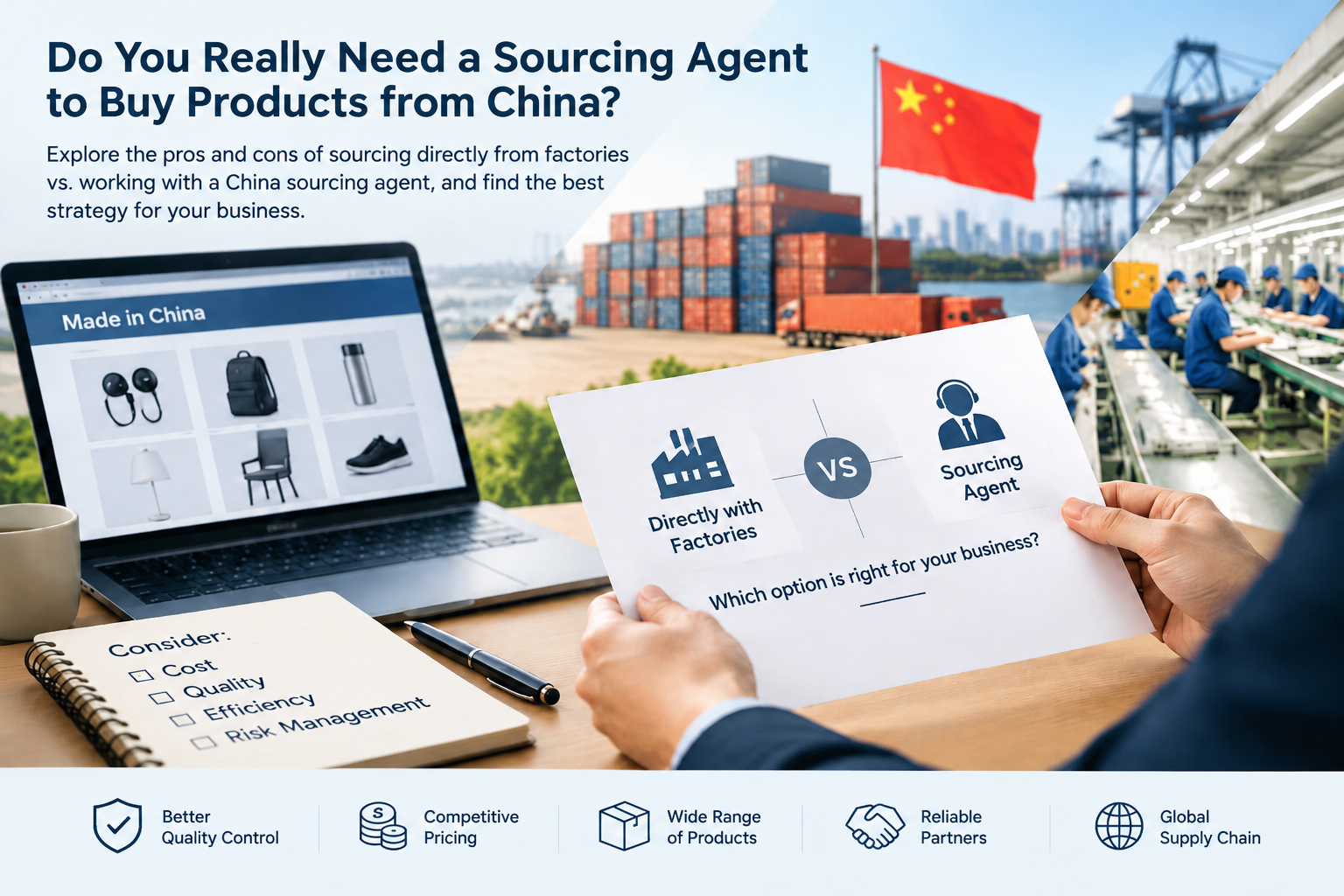
Do You Really Need a Sourcing Agent to Buy Products from China?
China is one of the world’s major manufacturing hubs, offering international buyers access to a wide range of products, competitive pricing, and extensive manufacturing capabilities.
However, for businesses planning to source products from China, one important question often comes up: Do you really need a sourcing agent, or can you work directly with factories?
The answer depends on your business size, sourcing experience, product requirements, and available resources.
In this article, we will explore both options to help you decide which sourcing strategy works best for your business.
1. Buying Directly from Chinese Factories
Working directly with manufacturers is a common choice for experienced importers and businesses with established purchasing teams.
Advantages of Direct Sourcing
More direct communication
You can discuss product specifications, customization, pricing, and production schedules directly with the factory.
Greater control over supplier relationships
Building direct relationships with manufacturers can help you develop long-term partnerships and improve your understanding of production capabilities.
Potential cost savings
By managing supplier communication and coordination internally, you may avoid paying an additional sourcing service fee. However, the total cost still depends on product pricing, order volume, logistics, inspection, and other expenses.
Challenges of Direct Sourcing
Despite these advantages, direct sourcing requires time, experience, and resources.
-
Finding reliable manufacturers among numerous suppliers can be time-consuming.
-
Communication gaps may lead to misunderstandings about product specifications.
-
Factory visits and quality inspections may be difficult to arrange from overseas.
-
Managing samples, production schedules, and multiple suppliers can increase your team’s workload.
-
Unexpected quality issues or delivery delays may require additional coordination.
For businesses with experienced purchasing teams and established supplier networks, these challenges may be manageable. For companies new to China sourcing, they can be more difficult to handle.
2. Buying Through a China Sourcing Agent
A China sourcing agent acts as a local partner, helping international buyers coordinate different stages of the procurement process.
Depending on the services provided, a sourcing agent may assist with supplier identification, quotation comparisons, sample coordination, factory communication, production follow-up, and quality control.
Advantages of Using a Sourcing Agent
Access to local sourcing support
A sourcing agent can help identify potential manufacturers and coordinate communication, making it easier to evaluate suppliers from overseas.
More efficient supplier management
If you need to purchase products from multiple factories, a sourcing agent can help coordinate quotations, samples, production schedules, and other purchasing activities.
Better production and quality oversight
A local team can arrange inspections, monitor production progress, and help identify potential problems before goods are shipped.
Support for businesses with limited sourcing experience
Companies without an established team in China can benefit from local assistance when evaluating suppliers, negotiating requirements, and managing orders.
What Should You Consider?
Using a sourcing agent also involves costs, and service quality varies between providers.
Before choosing an agent, clarify the service fees, scope of work, supplier relationships, quality inspection procedures, and reporting arrangements.
You should also ensure that the agent communicates transparently and acts in accordance with your business interests.
A sourcing agent should help you make better purchasing decisions, not simply add another layer of communication.
3. Direct Sourcing vs. Using a Sourcing Agent
Which option is better for your business? Here is a quick comparison.
| Factor | Direct Factory Sourcing | Using a Sourcing Agent |
|---|---|---|
| Supplier communication | Managed by your team | Coordinated with local support |
| Service fees | No agent fee, but internal costs remain | Additional service fees may apply |
| Supplier search | Requires your own research | Agent can assist with supplier identification |
| Quality inspections | Must be arranged by your team or a third party | Agent may coordinate local inspections |
| Multiple suppliers | Requires internal coordination | Can be easier to coordinate |
| Best suited for | Experienced buyers with sufficient resources | Businesses needing local support |
Neither option is automatically better. The right choice depends on how much sourcing work your team can manage effectively and what level of local support your business requires.
4. When Should You Consider Hiring a Sourcing Agent?
A sourcing agent may be particularly useful if your business faces any of the following situations:
You are sourcing from China for the first time.
You may need help understanding supplier capabilities, comparing quotations, and establishing a reliable purchasing process.
You purchase products from multiple factories.
Coordinating different suppliers, delivery schedules, product specifications, and quality requirements can become complicated as your product range grows.
You need customized products or packaging.
Private-label products and customized packaging often require detailed communication, sample approval, and production follow-up.
You cannot visit factories regularly.
A local sourcing partner can help coordinate factory visits, inspections, and production updates when your team is based overseas.
Your business is growing faster than your purchasing resources.
As order volumes and product categories expand, outsourcing some sourcing activities may allow your internal team to focus on sales, marketing, and business development.
5. How to Choose the Right Sourcing Approach
Before deciding whether to work with a sourcing agent, consider three important questions.
How much sourcing experience does your team have?
If you already have reliable factory relationships and a capable purchasing team, direct sourcing may be sufficient. If not, local support may help reduce the learning curve.
How complex is your supply chain?
Purchasing one standardized product from a trusted factory is different from managing multiple product categories, custom packaging, and several production partners.
What is the real cost of managing sourcing internally?
Consider not only supplier prices but also staff time, factory visits, inspection fees, shipping arrangements, and the potential cost of errors.
The goal is to find the sourcing model that provides the best balance of cost, quality, efficiency, and risk management.
Final Thoughts: Is a Sourcing Agent Necessary?
No. You do not always need a sourcing agent to buy products from China.
Experienced importers with established supplier relationships and strong internal purchasing teams may be perfectly capable of managing the process directly.
However, for businesses that need help finding manufacturers, coordinating multiple suppliers, monitoring production, or managing quality control, a reliable China sourcing agent can provide valuable local support.
The most important consideration is not whether you use an agent, but whether your sourcing process is reliable, transparent, and suited to your business needs.
Choose the Right YIWU sourcing agent for FIRST-TIME Buyers:
https://youtu.be/sEcJHLJ396A?si=mBPLCiuMTphKSEgg