You’ve perfected your product, but a hidden risk can instantly derail your launch: tooling ownership in China. Factories often hold molds hostage when you try to leave. If you’re searching for who owns the mold China supplier, you’re not alone. Let’s explore how to protect your brand.
The Asset Nobody Puts on the Balance Sheet
Here is a conversation we hear at least twice a month.
A founder wants to move production. Quality has slipped, prices have crept up, communication has gone cold. They tell the factory: “We’re moving the tooling to a new supplier.”
The factory replies: “The mold is ours.”
The founder: “I paid for it.”
The factory: “You paid us to make it. The tooling was made in our facility, by our toolmakers, on our machines.”
And legally, in most cases — the factory is right.
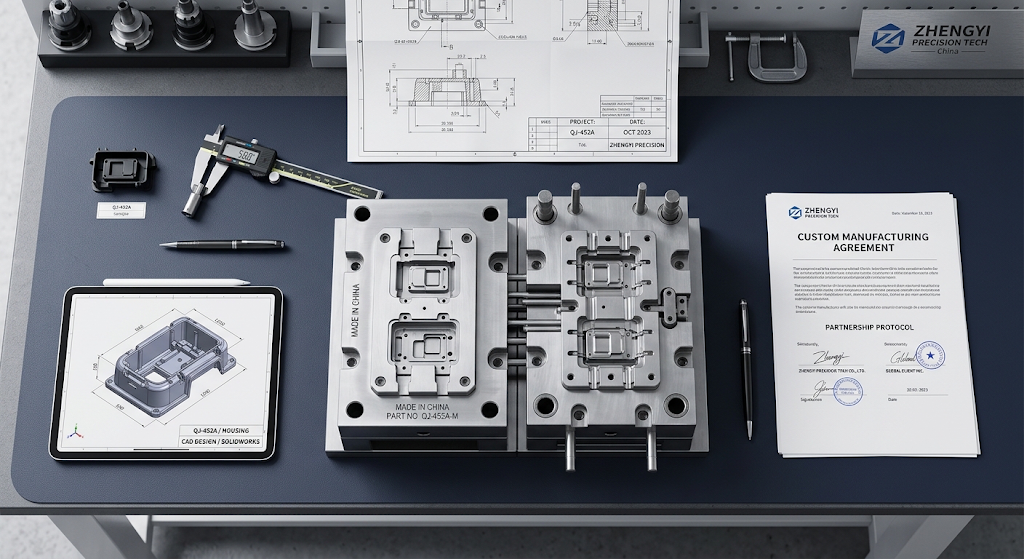
This is the part nobody explains when you place your first order. The mold (or tooling) is the steel or aluminum block that shapes every single unit you sell. A simple single-cavity mold might cost $3,000–$15,000. A multi-cavity family tool for a complex product can run $20,000–$80,000 or more. It is engineered for your product alone, it usually takes 20–45 days to build, and it physically sits in exactly one factory at a time.
It is, in every real sense, the heart of your supply chain. And most brands have no idea whose name is on it.

Three Ownership Scenarios — and How Each One Ends
Mold ownership is not a grey area. It comes down to three scenarios, and each one ends very differently.
| Scenario | What usually happens | Who really controls production |
|---|---|---|
| 1. You paid — contract silent | The factory treats the tooling as its own asset. Moving it requires their permission, and permission has a price. | The factory. You paid, but you rent. |
| 2. You paid — ownership clause + separate invoice | You hold written title. You can inspect, maintain, move, or duplicate the mold — on your schedule. | You. The factory is a service provider. |
| 3. “Free tooling” | The factory owns the mold and amortizes its cost inside your unit price. Leaving means leaving it behind. | The factory. You rent capacity. |
The “free tooling” trap
To be clear: free tooling is not always a scam. For short-run products, seasonal items, or a first test order, it can be a smart, low-risk deal. The problem is when it becomes the permanent arrangement for a product that turns into your bestseller.
Here’s why factories offer it: if they own the mold, you cannot take your product to another supplier without starting over. Every quote you receive for the rest of the product’s life starts from a weaker position. The factory knows exactly how much switching would cost you — and prices accordingly.
What Happens When the Factory Owns Your Mold
Nobody plans to get locked in. It happens slowly, through four doors.
1. You can’t switch suppliers — even when quality drops
Defect rates climb. Shipments arrive late. Emails take a week. Normally you would quote competitors and move. But with the mold sitting in their tool room, “moving” means paying for a brand-new tool — $5,000 to $80,000 — and waiting another month or two. Most brands tolerate a bad supplier far longer than they should, for exactly this reason.
2. Your “exclusive” product can still be sold to someone else
If the factory owns the mold, nothing physically stops them from running it on a night shift for another buyer — a competitor, a market-stall importer, anyone with a purchase order. Your design was never theirs to copy, but the tool that makes it sits in their building. A written exclusivity clause helps; owning the tooling removes the temptation entirely.
3. Prices only move in one direction
Material costs go up: the quote goes up. Labor goes up: the quote goes up. Exchange rates move: somehow, the quote still goes up. When re-tooling is the only alternative, every “cost increase” lands on a captive buyer. The discounts you negotiated in year one quietly disappear by year three.
4. The hostage scenario
The most expensive version: you decide to move, and the factory quotes a “mold release fee” of three to five times the actual cost of putting a tool on a pallet. Or they simply stop answering. With no ownership paperwork, your legal options in their jurisdiction are slow, costly, and uncertain.

How to Make Sure the Mold Is Legally Yours
Fixing this costs almost nothing — but only if you do it before you pay, not after. Five moves, in order.
1. Put the ownership clause in the contract
Not a handshake. Not a WeChat message. A signed agreement, in English and Chinese, that says who owns what. This is the single highest-leverage paragraph in your entire supplier contract.
2. Pay for tooling as a separate line item
Never bury the tooling cost inside the unit price. Ask for a separate invoice, labeled “TOOLING — PROPERTY OF [BRAND]”, paid by its own bank transfer. This single document becomes your proof of purchase if the relationship ever sours. It also stops the factory from later claiming the tool was their investment.
3. Engrave an ID and photograph everything
Before the mold leaves the tool room, have it engraved with a serial number — BRAND-2026-M01 — plus the cavity count and your company name. Photograph each plate with the engraving visible. Cheap, fast, and it makes the tool physically traceable as yours in any factory, warehouse, or dispute.
4. Keep a mold passport
A mold passport is a one-page record that travels with the tool: steel grade, cavity count, year built, shot count, maintenance history, and current location. Update it after every production run. When (not if) the mold moves to a second factory, this document saves weeks of re-engineering and guesswork.

5. Agree on the exit before you need it
The cheapest time to negotiate leaving is the day you arrive. Your agreement should state: a fixed release fee or formula (not “negotiable”), that your freight forwarder may collect the tool, and that the factory must cooperate with the handover. Fifteen minutes of awkward conversation now prevents a five-figure standoff later.
Red Flags: What to Ask Before You Pay
You don’t need a lawyer on the call. You need four questions — and you need to listen to how they’re answered.
| Ask this | A strong answer sounds like | Red flag |
|---|---|---|
| “If I stop ordering, can I move my mold?” | “Yes. Here is our release process and the fee formula — it’s in the contract.” | “The tooling stays with us. That’s our policy.” |
| “Who pays for mold maintenance?” | “There’s a fixed schedule; as the owner, you approve major work.” | “Don’t worry about it.” (Translation: no schedule, no records.) |
| “Will you run my mold for other customers?” | “No — exclusivity is written into the tooling agreement.” | “We can discuss it.” (They already have.) |
| “Can my new factory pick up the tool?” | “Sure — we’ll coordinate with your forwarder and hand over the passport.” | “Only we can handle the tooling. It’s very sensitive.” |
Frequently Asked Questions About Mold Ownership
Does paying for the mold automatically make me the owner?
Legally, no. Payment proves you funded it; a contract decides who owns it. Chinese courts look at the agreement, the invoices, and the tooling records — which is why all three should point the same way: at you.
What if I already accepted “free tooling”?
You can still negotiate. Ask to buy out the amortized tooling cost, or fund a second identical mold that you own outright. Once you have a mold you own in another factory, your quotes improve immediately.
Can I actually move a mold to another factory?
Yes — molds are designed to be lifted, palletized, and shipped. The practical steps are a release confirmation, the mold passport, and a forwarder who handles machinery. The hard part is never the physics; it’s the paperwork you didn’t do in year one.
Is mold ownership the same as IP protection?
No. Ownership controls the physical tool; IP (design patents, trademarks) controls the design. You need both. A mold you own still shouldn’t run for a competitor, and a design patent still matters if someone builds a copycat tool.
Do I need all this for a small first order?
Adjust to the stakes. For a $2,000 test mold, a clear email confirming ownership and a labeled invoice may be enough. For anything above roughly $5,000 — or any product you expect to scale — do all five moves properly.
What is a mold passport, practically?
One shared document (even a spreadsheet) listing: mold ID, steel grade, cavities, year, shot count, maintenance log, photos, and current location. Update it every production run and store it with your CAD files.
Get the Free Mold Ownership Checklist
Everything in this guide collapses into two documents you can send to any supplier today.
The exact contract clauses, invoice wording, and engraving standards — in English and Chinese — ready to hand to your supplier.
Get the checklistThe four questions from this guide, plus follow-ups for maintenance, exclusivity, and release — formatted for your next factory call.
Get the questionsNot sure who owns your tooling right now?
That uncertainty is the problem. Tell us what you make and where it’s made, and we’ll review your tooling position — contract, invoices, and exit plan — before it becomes a negotiation.
- Send us your current supplier agreement
- We flag the ownership gaps in plain language
- You get the fix-it checklist for your factory
Own the brand. Own the tooling.
Rent the machines.